

How to Support Your Partner’s Orgasm Without Creating Pressure
What to Say, What Not to Say, and How to Talk About Orgasm Difficulty
When a woman has difficulty orgasming with a partner, the subject can become a painful spot in the relationship.
A partner may try harder, repeatedly ask whether she is close, or become frustrated when orgasm does not happen. He may take her orgasm personally and wonder whether he is doing something wrong. She may begin worrying about disappointing him, protecting his feelings, or taking too long.
Instead of helping, these reactions can make orgasm even less accessible.
A supportive partner can care deeply about a woman’s pleasure without turning her orgasm into a test. Supporting orgasm means helping create the conditions in which pleasure, arousal, absorption, and orgasm may become more accessible. It does not mean requiring her body to produce an orgasm.
Supporting an Orgasm Is Not the Same as Requiring One
Participants described partners repeatedly asking whether they were close, demanding that they orgasm, expressing frustration, using guilt, or treating orgasm as proof of their own sexual competence.
Importantly, being pressured to orgasm was associated with faking orgasm and negative emotional and relationship outcomes.
This research gives us an important distinction:
Supporting an orgasm is not the same as requiring an orgasm.
Even when a partner has positive intentions, persistent monitoring can turn orgasm into an obligation. As a result, a woman may stop focusing on sensation and begin wondering whether she is taking too long, whether her partner is disappointed, or whether she needs to orgasm to reassure him.
For some couples, taking the pressure off orgasm can shift attention away from performance and back toward pleasure, sensation, and connection.
How Partners Talk About Orgasm Matters
Research consistently connects better sexual communication with greater sexual functioning and satisfaction.
A meta-analysis of 48 studies found that sexual communication was positively associated with desire, arousal, lubrication, orgasm, reduced pain, and overall sexual functioning. The association between sexual communication and orgasm was stronger for women than for men.
However, simply talking more is not necessarily enough.
A second meta-analysis included 93 studies and 38,499 people. Sexual communication was associated with both sexual and relationship satisfaction, but the quality of the communication mattered more than how frequently couples talked about sex.
It is not enough to ask whether couples talk about orgasm.
How they talk about it matters.
A conversation filled with blame, interrogation, defensiveness, or disappointment may add pressure. In contrast, a conversation guided by curiosity, acceptance, and a genuine desire to understand can create greater emotional safety.
Many Women Remain Silent to Protect Their Partners
Women may avoid talking about orgasm difficulty because they do not want to hurt their partner’s feelings.
In a nationally representative study of 1,008 American women:
- 55.4 percent had wanted to communicate something about sex but decided not to.
- 42.4 percent remained silent because they did not want to hurt their partner’s feelings.
- 40.2 percent did not feel comfortable discussing the details.
- 37.7 percent felt embarrassed.
Furthermore, women who continued to fake orgasms reported more embarrassment about explicit sexual communication and less ability to tell their partners what made sex pleasurable. Greater comfort with sexual communication, however, was associated with greater sexual satisfaction.
Ignoring orgasm difficulty does not necessarily make the problem disappear. Although silence may temporarily protect a partner’s feelings, it can also prevent the couple from discovering what would make pleasure and orgasm more accessible.
For women who find it harder to orgasm with a partner, communication may help reveal differences in stimulation, pressure, attention, or sexual expectations that would otherwise remain hidden.
Partners May Not Know What Is Actually Happening
Avoiding the subject can also allow misperceptions to continue.
A nationally representative study of 1,683 newlywed heterosexual couples found that 43 percent of husbands misperceived how frequently their wives experienced orgasm.
A partner may believe that orgasm is happening more frequently than it is. He may also assume that the stimulation he provides is working because his partner has never felt comfortable telling him otherwise.
Talking honestly about orgasm does not have to be an accusation. It can become an opportunity to learn together.
A Woman’s Orgasm Is Not a Grade on Her Partner
Some partners take orgasm difficulty as evidence that they are inadequate lovers.
However, a woman’s orgasmic response may be influenced by many factors, including arousal, attention, hormonal changes, medication, stress, fatigue, body image, sexual history, relationship dynamics, the kind of stimulation being provided, and whether she feels pressure to orgasm.
A 2025 study followed 102 couples through an initial assessment, 28 days of daily diaries, and a four-month follow-up. On days when women experienced greater orgasm difficulty, they reported lower sexual satisfaction and greater sexual distress. However, their orgasm difficulty was not associated with their male partners’ sexual satisfaction or distress on those days.
A woman’s orgasm difficulty does not automatically mean that her partner is failing or that the sexual experience has failed.
Moving ego and self-judgment out of the bedroom allows a partner to become more curious. He does not have to know everything in advance. He can listen, learn, ask for guidance, and become more responsive to the individual woman he is with.
Knowledge and Sexual Skills Matter Too
Emotional safety is important, but supportive words alone do not necessarily resolve orgasm difficulty.
Partners can also increase their knowledge of female orgasm and develop better sexual skills.
This may include:
- Learning the type of stimulation that already works for her.
- Understanding the importance of clitoral stimulation.
- Maintaining a rhythm or pressure that feels good instead of constantly changing techniques.
- Allowing sufficient time for arousal to develop.
- Welcoming self-touch, vibrators, or other forms of stimulation.
- Listening to guidance without becoming defensive.
- Recognizing that stronger or faster stimulation is not always better.
A partner does not have to personally produce every sensation.
In fact, bringing familiar stimulation into partnered sex may help women who can orgasm alone but have difficulty orgasming with a partner.
For some women, this may include self-touch. Others may benefit from clitoral stimulation, different positions, or introducing a vibrator to partnered sex.
Welcoming the stimulation that helps her is not evidence of inadequacy. Instead, it shows that her pleasure matters more than receiving credit for creating it.
What Not to Say When Your Partner Can’t Orgasm
Research has not experimentally tested every individual sentence. However, orgasm-coercion and sexual-communication research supports avoiding comments that turn orgasm into an obligation, measurement, or evaluation.
Comments that may create pressure include:
- “Why haven’t you come yet?”
- “Are you close?” when asked repeatedly
- “I need you to finish.”
- “What am I doing wrong?”
- “We have been doing this forever.”
- “Just relax.”
- “You came with someone else, so why can’t you come with me?”
- “I’m not stopping until you come.”
Although these statements may come from frustration or even a desire to help, they can shift attention away from pleasure.
Instead, the woman may begin thinking about time, performance, her partner’s feelings, or whether she is disappointing him.
Pressure can also be communicated without words. For example, sighing, pouting, withdrawing, becoming defensive, or acting rejected when orgasm does not happen can send a similar message.or example, sighing, pouting, withdrawing, becoming defensive, or acting rejected when orgasm does not happen can send a similar message.
Comments That Can Help Create Safety
Supportive communication removes the demand for a particular outcome while keeping pleasure important.
The following phrases have not been individually tested in clinical trials. However, they reflect the responsive and autonomy-supportive communication found throughout the research:
- “There is no pressure to orgasm.”
- “Tell me what feels good, and we can change anything that doesn’t.”
- “Your pleasure matters even if orgasm doesn’t happen tonight.”
- “Would you like more, less, slower, faster, or something different?”
- “You don’t have to protect my feelings. I want to understand your experience.”
- “This is something we can explore together, not something you have to accomplish for me.”
- “Your orgasm is not a grade on my sexual ability.”
Notice the difference.
These statements do not tell a woman what she should feel. Instead, they give her room to communicate what she actually feels.
Feeling understood, accepted, and cared for is associated with greater sexual well-being.
Research involving couples coping with genito-pelvic pain also found that greater perceived partner responsiveness was associated with greater sexual functioning and satisfaction.
Although sexual pain and orgasm difficulty are different concerns, both studies support the importance of feeling understood, accepted, and cared for when discussing a sensitive sexual issue.
Creating the Conditions for Orgasm
A supportive partner remains interested in her pleasure without making her responsible for producing an orgasm.
He brings curiosity instead of assumptions and listens without defensiveness. In addition, he is willing to learn what stimulation works for her.
He can welcome self-touch, clitoral stimulation, and vibrators rather than viewing them as competition. Likewise, he can allow sufficient time for arousal, maintain stimulation that feels good, and avoid making the outcome about his ego.
Ultimately, supporting a woman who has difficulty orgasming with a partner means helping create the conditions in which orgasm may become more accessible:
Knowledge, sexual skill, effective stimulation, communication, emotional safety, sufficient time, and freedom from pressure.
It does not mean requiring her body to produce an orgasm.
Her orgasm is not a performance.
It is not reassurance.
And it is not a grade on her partner.
Pleasure can matter deeply without orgasm becoming an obligation.
Watch the Full Episode
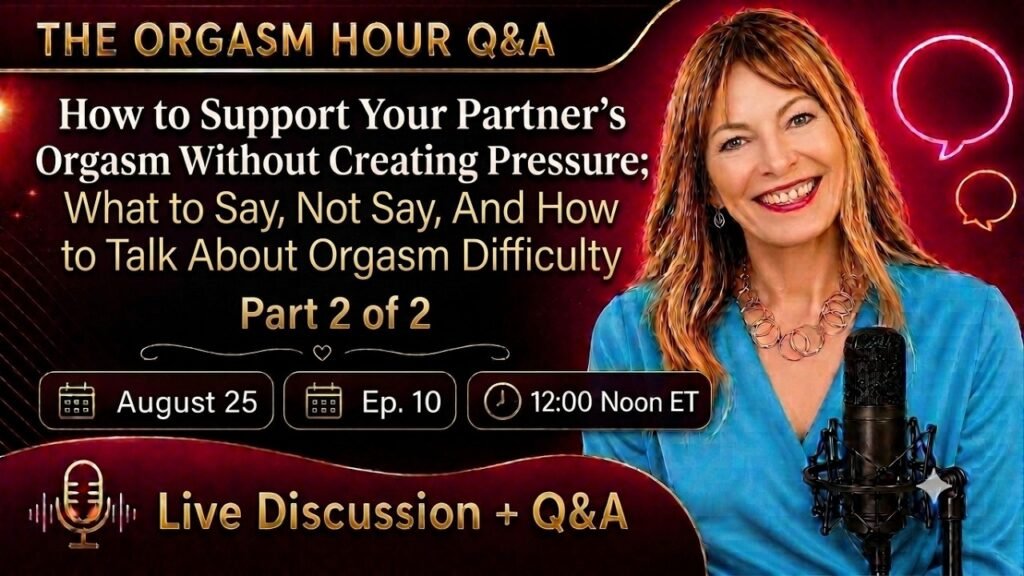
Watch The Orgasm Hour Q&A on our YouTube channel, where Dr. Suzanne Mulvehill explores orgasm, sexual health, relationships, women’s health, culture, consciousness, and the historical forces that shape our intimate lives.
You can also catch every episode of The Orgasm Hour Q&A on 10 podcast platforms.
Subscribe to our YouTube channel so you do not miss an upcoming episode, and follow Dr. Suzanne Mulvehill on social media at @drsuzannemulvehill.
References
Belu, C. F., & Rosen, N. O. (2025). Associations Between Women’s Orgasm Experiences, Perceived Partner Responsiveness, and Sexual Well-Being Among Community Women and Their Partners: A Dyadic and Prospective Study. Archives of sexual behavior, 54(9), 3597–3612. https://doi.org/10.1007/s10508-025-03274-4
Bergeron, S., Pâquet, M., Steben, M., & Rosen, N. O. (2021). Perceived partner responsiveness is associated with sexual well-being in couples with genito-pelvic pain. Journal of family psychology : JFP : journal of the Division of Family Psychology of the American Psychological Association (Division 43), 35(5), 628–638. https://doi.org/10.1037/fam0000829
Chadwick, S. B., & van Anders, S. M. (2022). Orgasm Coercion: Overlaps Between Pressuring Someone to Orgasm and Sexual Coercion. Archives of sexual behavior, 51(1), 633–651. https://doi.org/10.1007/s10508-021-02156-9
Herbenick, D., Eastman-Mueller, H., Fu, T. C., Dodge, B., Ponander, K., & Sanders, S. A. (2019). Women’s Sexual Satisfaction, Communication, and Reasons for (No Longer) Faking Orgasm: Findings from a U.S. Probability Sample. Archives of sexual behavior, 48(8), 2461–2472. https://doi.org/10.1007/s10508-019-01493-0
Leonhardt, N. D., Willoughby, B. J., Busby, D. M., Yorgason, J. B., & Holmes, E. K. (2018). The Significance of the Female Orgasm: A Nationally Representative, Dyadic Study of Newlyweds’ Orgasm Experience. The journal of sexual medicine, 15(8), 1140–1148. https://doi.org/10.1016/j.jsxm.2018.05.018
Mallory, A. B., Stanton, A. M., & Handy, A. B. (2019). Couples’ Sexual Communication and Dimensions of Sexual Function: A Meta-Analysis. Journal of sex research, 56(7), 882–898. https://doi.org/10.1080/00224499.2019.1568375
Mallory A. B. (2022). Dimensions of couples’ sexual communication, relationship satisfaction, and sexual satisfaction: A meta-analysis. Journal of family psychology : JFP : journal of the Division of Family Psychology of the American Psychological Association (Division 43), 36(3), 358–371. https://doi.org/10.1037/fam0000946
Merwin, K. E., & Rosen, N. O. (2020). Perceived Partner Responsiveness Moderates the Associations Between Sexual Talk and Sexual and Relationship Well-Being in Individuals in Long-Term Relationships. Journal of sex research, 57(3), 351–364. https://doi.org/10.1080/00224499.2019.1610151

You may also like

How to Orgasm With a Partner

Penis Injuries During Sex: What Every Partner Should Know