

Why Is It Harder to Orgasm With a Partner? And What to Do About It
Can you orgasm alone but not with a partner? Learn why orgasm can be harder during partnered sex and how communication, clitoral stimulation, emotional safety, attention, and orgasmic learning may help.
Many women can orgasm during masturbation but find it much more difficult during partnered sex. Others have never experienced orgasm, whether alone or with a partner.
If you’ve ever wondered, “Why is it harder to orgasm with a partner?” you’re not alone.
Female orgasm during partnered sex is influenced by much more than physical stimulation. Attention, emotional safety, communication, relationship dynamics, sexual techniques, and psychological factors can all influence a woman’s sexual experience.
Therefore, understanding these factors can help shift the conversation away from blame and toward practical, compassionate solutions.
What Is the Orgasm Gap?
Researchers use the term orgasm gap to describe the persistent difference between how frequently men and women report orgasming during partnered sexual activity.
In a 2024 study involving nearly 25,000 adults in the United States, men reported orgasming substantially more often than women across every age group. Age made relatively little difference. The largest gap appeared in heterosexual relationships, while women in same-sex relationships reported higher orgasm rates.
This does not mean that women’s bodies are inherently less capable of orgasm. It suggests that the sexual practices, expectations, and relationship dynamics surrounding partnered sex often support men’s orgasms more effectively than women’s.
One major contributor is our cultural emphasis on penetration.
Most women do not reliably orgasm from vaginal penetration alone. Yet penetrative sex is still frequently treated as the central event, while clitoral stimulation is considered optional, secondary, or merely a form of foreplay.
Pornography can reinforce this misunderstanding. It often portrays women orgasming rapidly through penetration, sometimes with dramatic ejaculation or squirting. These depictions may be created for entertainment, but they are not reliable sex education.
Why Is It Easier to Orgasm Alone Than With a Partner?
When a woman is alone, she may have more control over the pressure, speed, rhythm, location, fantasy, and duration of stimulation. She can concentrate on her own sensations without monitoring another person’s experience.
During partnered sex, her attention may become divided.
She may be wondering:
- Is my partner enjoying this?
- Am I taking too long?
- Does my body look attractive?
- Am I going to orgasm this time?
- Is my partner becoming frustrated?
- Should I pretend that this feels better than it does?
These thoughts involve self-monitoring and evaluation. They can keep the brain in an analytical state rather than allowing the woman to become absorbed in sensation.
Orgasm generally becomes more accessible when a person can move away from constant monitoring and enter a state of concentration, imagination, pleasure, and bodily awareness.
This is why commanding someone to relax or repeatedly asking whether she is close rarely helps. These questions can increase the very pressure that is interfering with her response.
How Performance Pressure Can Make Orgasm Harder
Approximately half of women who report orgasm difficulty during partnered sex also report feeling distressed by it.
That distress can become part of the sexual experience itself.
When a woman begins anticipating disappointment, frustration, judgment, or failure, her nervous system may interpret the sexual situation as threatening. She may experience tension, distraction, reduced sensation, numbness, or difficulty remaining aroused.
The pressure may come from her partner, but it can also become internalized. She may begin placing pressure on herself before her partner says anything.
The mind starts asking, “Will it happen this time?”
The body may respond by tightening, withdrawing, or becoming less responsive.
This creates a painful cycle:
Pressure makes orgasm harder.
Difficulty orgasming creates more pressure.
More pressure makes the next experience even harder.
Breaking this cycle begins with removing orgasm as a test that must be passed.
Pain During Sex Should Never Be Ignored
Some women continue penetrative sex even when it is painful because they want their partners to orgasm. Others become numb or mentally check out but say nothing because they do not want to interrupt the experience.
This teaches the nervous system that sexual activity may involve enduring discomfort for someone else’s benefit.
Pain during sex should not be ignored.
When a woman continues despite pain, her body may learn that it cannot trust her to protect it. That loss of bodily trust can make relaxation, arousal, pleasure, and orgasm increasingly difficult.
Stopping is not selfish. Saying that something hurts is not a rejection of the partner. It is an essential act of communication and bodily protection.
Persistent or recurring sexual pain should also be evaluated by an appropriate healthcare professional. Pain may have physical, hormonal, pelvic floor, neurological, psychological, or relational contributors.
Why Many Women Put Their Partner’s Pleasure First
Research examining the determinants of women’s orgasms has found that mental and relationship factors can be more important than sexual experience, number of partners, or masturbation history.
Factors associated with more frequent orgasm include:
- Believing that the woman’s orgasm matters
- Sexual self-esteem
- Sexual desire
- The ability to concentrate and become absorbed
- Open sexual communication
- Mutual initiation of sexual activity
- Effective stimulation and sexual techniques
- A relationship that feels emotionally safe and supportive
One especially important finding is that women frequently value their partners’ orgasms more than their own.
This imbalance can appear in subtle ways. A woman may remain silent when stimulation does not feel good. She may tolerate painful penetration, pretend to orgasm, or allow the sexual encounter to end immediately after her partner climaxes.
Over time, the couple may develop a repetitive sexual script that reliably produces one partner’s orgasm while leaving the other partner’s needs unexplored.
Why Communication Before Sex Matters
Communication is one of the most useful tools for changing an established sexual routine.
However, the middle of sex isn’t always the easiest time to begin a complicated conversation.
Instead, consider talking before sexual activity begins.
For example, you might say:
“I want us to try something different next time.”
“I’ve noticed that I sometimes become numb or uncomfortable, but I haven’t been speaking up.”
“I’d like us to slow down and pay more attention to what my body responds to.”
“I want us to explore pleasure without making orgasm the immediate goal.”
These conversations don’t have to be criticisms of your partner.
Rather, they can become invitations to explore together.
When both people understand that pleasure is something they can learn about not something they’re expected to automatically know, there may be more room for curiosity and less pressure to perform.
Emotional Safety Supports Female Pleasure
A relationship that feels good emotionally can help support orgasm.
This does not mean every relationship must be perfect. It does mean that a woman needs enough safety to be vulnerable, communicate honestly, and remain connected to her body.
Emotional abuse, coercion, humiliation, chronic criticism, inequality, and domestic violence can profoundly affect sexual response. A nervous system that is protecting itself may not be able to surrender into pleasure simply because sexual stimulation is occurring.
Even consensual dominance and submission depend on communication, trust, and genuine choice. Consensual erotic power exchange is very different from being controlled or silenced.
Sexual openness, appreciation, equality, and emotional connection create conditions in which pleasure is more likely to develop.
There Is More Than One Way to Experience Orgasm
Our culture commonly treats genital stimulation as the only legitimate pathway to orgasm. Research and case studies, however, have documented orgasmic responses associated with several other pathways, including:
- Erotic imagination and fantasy
- Hypnotic induction
- Breathwork
- Tantra and yoga
- Pelvic floor movement
- Mindfulness and meditative absorption
- Non-genital stimulation
- Altered states of consciousness
These pathways do not mean genital stimulation is unimportant. They show that orgasm is not merely a mechanical reflex located in the genitals. It is a whole-body and brain-based response influenced by attention, expectation, safety, learning, sensation, and consciousness.
Different women may respond to different pathways. A woman whose orgasm difficulty is connected to pain, trauma, medication, hormonal changes, anxiety, distraction, or loss of sensation may need a different approach from someone who has never learned how to recognize or build arousal.
There is no single technique that will be right for every woman.
Can Cannabis Help Some Women Orgasm?
My own experience with orgasm difficulty led me to study women’s use of cannabis before partnered sex.
For approximately 30 years, despite working with several sex therapists and trying multiple approaches, I continued to experience difficulty accessing orgasm during partnered sex. Cannabis eventually helped create the internal conditions in which orgasm became available to me.
That experience led to a peer-reviewed observational study examining cannabis use before partnered sex.
Among participants who reported orgasm difficulty, 72.8 percent said cannabis use before partnered sex increased orgasm frequency. Approximately 67 percent reported improved orgasm satisfaction, and 71 percent reported that orgasm became easier.
These findings do not establish cannabis as a validated treatment, and cannabis is not appropriate for everyone. However, the results suggest that cannabis may help some women create conditions associated with orgasmic access, such as reduced self-monitoring, increased sensory awareness, less anxiety, greater mental absorption, or a shift in consciousness.
Cannabis should never be treated as a universal solution. Anyone considering medical cannabis should discuss individual risks, medications, mental health history, dosage, and legal considerations with a qualified healthcare professional.
When cannabis is used, the guiding principle should be: go low and go slow.
How to Create the Conditions That Support Orgasm
The goal is not to force the body to orgasm.
The goal is to create the physical, mental, emotional, and relational conditions in which orgasm becomes possible.
That may involve:
- Slowing down
- Stopping when something hurts
- Giving clitoral stimulation the time and attention it requires
- Allowing pleasure to matter even when orgasm does not occur
- Talking openly outside the bedroom
- Changing repetitive sexual patterns
- Learning to concentrate on sensation instead of monitoring orgasm
- Exploring fantasy, breath, movement, mindfulness, or other pathways into absorption
Most importantly, it means recognizing that a woman’s orgasm is not an optional addition to her partner’s sexual experience.
Her pleasure, voice, boundaries, and bodily safety matter.
Why Your Voice Matters
Women have often been taught to remain modest, accommodate others, avoid difficult conversations, and disconnect from their own wants. Unfortunately, these patterns do not necessarily disappear when we enter the bedroom.
Learning to express what feels good, what does not, when something needs to stop, and what you would like to explore can be a profound part of orgasmic learning.
Finding and using your voice can help protect your body, interrupt old sexual patterns, and create a greater sense of safety. At the same time, communicating your needs makes room for your own pleasure to become an important part of the sexual experience.
Continue the Conversation
This blog was adapted from Episode 3 of The Orgasm Hour Q&A on our YouTube channel, where Dr. Suzanne Mulvehill explores the science, psychology, and lived experience of orgasm and pleasure.
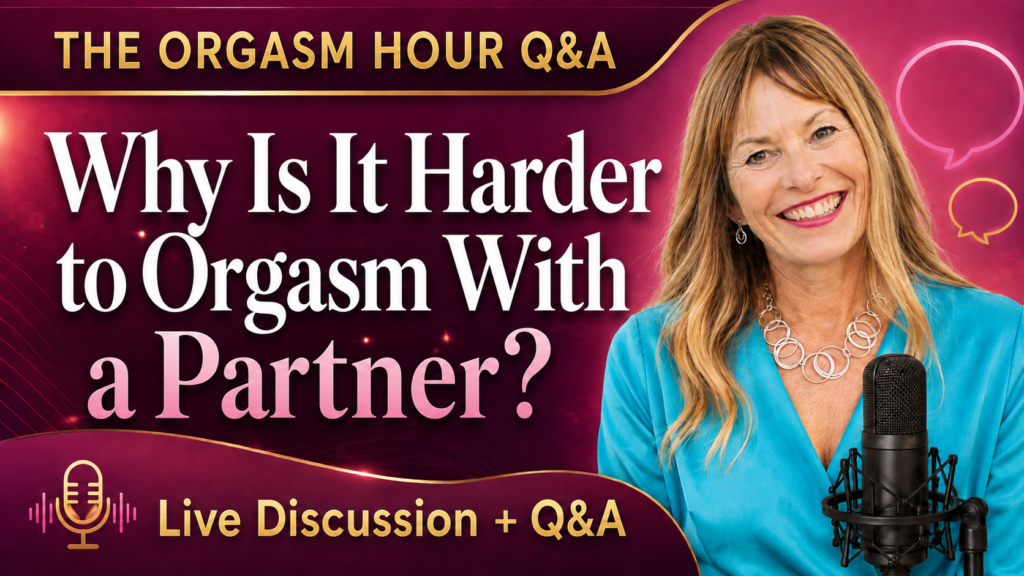
You can also catch every episode of The Orgasm Hour Q&A on 10 podcast platforms.
Subscribe to our YouTube channel so you do not miss an upcoming episode, and follow Dr. Suzanne Mulvehill on social media at @drsuzannemulvehill.
Educational disclaimer: This article is intended for general educational purposes and is not a substitute for individualized medical, psychological, or sexual health care. Seek professional evaluation for persistent orgasm difficulty, pain during sex, trauma-related symptoms, medication concerns, or other changes in sexual functioning.

You may also like

How to Support Your Partner’s Orgasm Without Creating Pressure

How to Orgasm With a Partner