

How to Develop Your Erotic Imagination
Want to learn how to develop your erotic imagination? Discover practical fantasy exercises that may help build sexual desire, deepen pleasure, reduce distraction, and support orgasmic learning.
Many women ask:
“Why can’t I fantasize?” or “How do I develop my erotic imagination?”
For some people, sexual fantasy seems to happen naturally. They close their eyes, imagine a scene, become absorbed in it, and notice their bodies beginning to respond.
For others, however, erotic imagination feels frustratingly out of reach.
They may try to fantasize but quickly become distracted. They may watch something erotic and feel nothing. Eventually, they may conclude that fantasy simply isn’t something they’re capable of.
But erotic imagination isn’t necessarily something you either have or don’t have.
Instead, like meditation, learning an instrument, or developing another skill, erotic imagination can often be strengthened through patience, practice, and repetition.
Learning how to develop it may offer another pathway toward sexual desire, pleasure, and orgasmic learning.
Why Erotic Imagination Can Be Learned
We live in a culture of immediate results.
We can heat coffee in 30 seconds, order an item and receive it within hours, or search for an answer the moment a question enters our minds. As a result, we may unconsciously expect our bodies to respond with the same speed.
For example, a woman may try a vibrator once or twice and feel disappointed that she did not orgasm. She may watch pornography and become frustrated when it doesn’t create arousal. Likewise, she may attempt to fantasize but stop because her thoughts wander.
Over time, that frustration can become part of the problem.
Orgasmic learning is rarely like placing a drink in a microwave and waiting 30 seconds.
Instead, think of it more like training to run a mile.
You wouldn’t expect to run comfortably after two attempts, especially if you hadn’t exercised in years. You would begin slowly, notice your capacity, practice regularly, and allow your body to adapt.
Erotic imagination can be approached in much the same way.
Rather than asking:
“Why isn’t this working?”
try asking:
“What am I learning to notice?”
That shift matters. Frustration, impatience, and self-criticism can make it harder to enter the relaxed, absorbed state that may support fantasy, arousal, and orgasm.
What Is Erotic Imagination?
Imagery is the mind’s ability to create or recreate sensory experiences without those experiences occurring directly in the external world.
You can imagine:
- A place
- A face
- A voice
- A scent
- A texture
- A movement
- A conversation
- A feeling
- A scene that has never happened
Imagination allows you to combine these mental images into something new.
Erotic imagination applies this capacity to experiences that feel intimate, sensual, emotionally charged, romantic, exciting, taboo, comforting, powerful, playful, or sexually arousing.
An erotic fantasy does not need to be realistic. It does not need to involve something you would want to experience in your actual life. It does not need to reflect your values, identity, relationship preferences, or plans.
Fantasy is a private mental space.
You are allowed to imagine without acting.
You can explore a scenario mentally without wanting it to happen physically.
Feel free to discover that what arouses your imagination is different from what you would choose in a real relationship.
Why Erotic Imagination Supports Female Pleasure
Human sexual response is influenced not only by what happens to the body but also by where attention is directed.
You can focus externally on touch, movement, sound, your partner’s body, or the physical environment. You can also direct attention internally toward memories, emotions, fantasies, and imagined sensations.
These internally generated experiences can influence arousal even when physical stimulation is limited or absent.
This helps explain why the same type of touch can feel very different depending on what is happening in the mind.
Touch may feel pleasurable when you are relaxed, absorbed, safe, and interested. The same touch may feel neutral or irritating when you are distracted, anxious, self-conscious, resentful, or monitoring whether you are becoming aroused quickly enough.
Erotic imagination gives attention somewhere pleasurable to go.
Rather than remaining trapped in thoughts such as, “Why am I not responding?” or “Will I orgasm this time?” the mind can begin building an experience that supports curiosity and sensation.
How Cognitive Distraction Can Interrupt Fantasy and Orgasm
Many women experiencing difficulty reaching orgasm describe being unable to stop thinking during sex.
Sometimes, those thoughts involve everyday responsibilities:
- Did I lock the door?
- What do I need to do tomorrow?
- Are the children still awake?
- Did I answer that email?
At other times, the distraction comes from sexual self-monitoring:
- Am I taking too long?
- Does my body look attractive?
- Is my partner getting bored?
- Am I close yet?
- Why am I not feeling more?
- What is wrong with me?
This internal commentary divides attention.
In other words, one part of the mind is trying to experience pleasure while another part is watching, measuring, and judging the experience.
As a result, instead of becoming absorbed, you may begin observing your own body from the outside.
Erotic imagination may help redirect attention away from constant judgment and toward emotionally meaningful imagery.
Of course, this doesn’t mean every distracting thought will disappear.
The practice is simpler: notice when your mind wanders and gently guide your attention back toward the scene, sensation, or image you’re developing.
Breaking the Cycle of Frustration
For many women, orgasm difficulty develops into a cycle of hope and frustration.
They enter a sexual experience hoping that this will finally be the time they orgasm. As stimulation continues, they begin evaluating whether it is working. When orgasm does not happen, they feel disappointed, inadequate, or angry with their bodies.
The next time, they carry that disappointment with them.
The cycle may sound like this:
“Maybe it will happen this time.”
“Why is it taking so long?”
“I am losing the feeling.”
“It is not going to happen.”
“My body is broken.”
“I do not want to try anymore.”
This pattern can create negative associations with sex, self-touch, fantasy, and orgasm itself.
One way to interrupt the cycle is to stop treating every sexual experience as an orgasm test.
Instead, consider entering an orgasmic learning process.
The purpose of a practice session is not necessarily to orgasm. It may be to notice one image, remain present for two minutes longer, identify one type of touch you enjoy, or create one fantasy detail that produces curiosity.
Progress may begin before orgasm occurs.
Be Compassionate With Your Body
SoAfter struggling for a long time, some women begin to feel betrayed by their bodies.
They may experience numbness, low desire, difficulty becoming aroused, pain, or the absence of orgasm. Consequently, years of frustration can turn into anger toward the body itself.
However, your body may not be betraying you.
Instead, it may be responding to pressure, fear, shame, distraction, pain, relationship stress, hormonal changes, medication effects, or patterns learned over time.
A more compassionate inner conversation might sound like:
- “My response doesn’t have to happen immediately.”
- “I’m learning something new.”
- “I can practice without demanding a result.”
- “I can stop if I feel overwhelmed.”
- “I don’t need to punish myself for becoming distracted.”
Compassion doesn’t mean pretending you’re not frustrated.
Rather, it means refusing to use that frustration against yourself.
Begin With Nonsexual Imagination Training
One of the most interesting features of early imagination-training approaches was that they did not begin with explicit sexual fantasy. Instead, the first step was simply to strengthen the imagination itself.
For example, a person might study a painting and describe it in detail, paying attention to the colors, lighting, people, and emotions within the scene. They might also imagine what happened before that moment or what could happen next.
You can practice this exercise with any piece of visual art. Choose an image and spend five minutes examining its details. Then, close your eyes and try to reconstruct the scene in your mind.
Try to remember:
- The colors
- The placement of objects
- Facial expressions
- Clothing
- Light and shadow
- Movement
- The emotional atmosphere
You can also read descriptive fiction and pause to construct the scene in your mind.
What does the room look like? What’s the temperature? What sounds are present? How does the fabric feel? What expression is on the person’s face?
This develops the mental muscles involved in creating vivid imagery without immediately introducing the pressure to become sexually aroused.
Make Your Erotic Imagination More Vivid
Once you become more comfortable creating mental images, begin adding sensory information.
Imagine walking into a beautiful room.
What do you see?
What can you hear?
Is there music?
What does the air smell like?
What are you wearing?
How does the fabric feel against your skin?
Is the room warm or cool?
Does someone enter?
How does their presence change the emotional atmosphere?
Erotic imagination becomes more vivid when it involves more than visual images. Some people respond more strongly to words, voices, movement, touch, emotional tension, anticipation, power, romance, or the feeling of being desired.
You do not have to visualize clearly to have an erotic imagination.
Your fantasy may be experienced as a story, a bodily feeling, a remembered phrase, an emotional atmosphere, or an internal sense of what is happening.
Writing Fantasy Can Strengthen Erotic Imagination
A recent randomized controlled study discussed in Episode 4 examined a simple home-based fantasy exercise.
Participants in the sexual fantasy group were instructed to write an erotic narrative at least twice a week. A comparison group wrote positive but nonsexual narratives.
After four weeks, the participants practicing sexual fantasy reported increases in sexual desire, pleasure, and the vividness of partner-focused imagination. They also reported reductions in sexual distress and sexual worries.
The exercise was not complicated.
They practiced writing an erotic narrative twice a week for four weeks.
You can create your own version of this practice.
Set aside 10 to 20 minutes. Turn off notifications and choose a private place where you are unlikely to be interrupted.
Begin with one sentence:
“I enter the room and notice…”
“I feel most desired when…”
“The scene begins when…”
“Imagine being touched…”
“I hear someone say…”
“I always wondered what it would feel like to…”
Do not worry about whether the writing is good. This is not a literary assignment. You are not writing for publication or for anyone else to read.
The purpose is to direct your attention toward an emotionally meaningful and potentially arousing scene.
A Four-Week Erotic Imagination Practice
Try writing twice a week for four weeks.
Week One: Build the Setting
First, focus on the environment.
Where are you?
What time of day is it?
What are you wearing?
What’s the emotional atmosphere?
Who is present, if anyone?
There does not need to be any sexual activity yet.
Week Two: Introduce Anticipation
Next, add attraction, curiosity, flirtation, or suspense.
What is communicated through eye contact?
Do you hope something will happen?
What remains unspoken?
What makes the scene feel exciting?
Week Three: Add Sensation
Describe touch, pressure, warmth, breath, movement, sound, and bodily response.
Write what feels pleasurable rather than what you think is supposed to be pleasurable.
Week Four: Follow the Fantasy
Allow the scene to develop without judging where it goes.
You remain in control of the exercise. You can pause, change the scene, remove a character, alter the setting, or stop entirely.
At the end of each session, briefly note what captured your attention.
You might write:
- “I responded to the anticipation more than the touch.”
- “I liked feeling pursued.”
- “I preferred directing the scene.”
- “I noticed that words affected me more than visual details.”
- “I became distracted, but I returned to the story.”
These observations can teach you something about your erotic mind.
Let Go of Self-Criticism
When you notice yourself thinking, “This is stupid,” “I cannot do this,” or “Nothing is happening,” pause.
You do not need to fight the thought. Instead, simply name it:
“That is self-criticism.”
Then, gently return your attention to one detail in the imagined scene. Notice what might happen next, what sounds are present, and what emotions begin to emerge.
From there, ask yourself what could make the situation feel more interesting, vivid, or engaging.
Each time you gently return your attention, you’re practicing the skill.
Erotic Fantasy Isn’t Another Performance
Developing your sexual imagination shouldn’t become another standard you believe you must meet.
You don’t need to create a perfect fantasy.
Likewise, you don’t have to become aroused every time you practice.
You don’t have to share your fantasies with a partner unless you choose to. Nor do you have to act out anything you imagine.
Furthermore, pornography isn’t required to develop erotic imagination.
Some people may find erotic literature, audio, artwork, music, memories, guided imagery, or their own writing more engaging.
Ultimately, the practice should serve your mind and body, not force them into another narrow sexual script.
Other Ways to Develop Erotic Imagination
Some people access imagination through relaxation, meditation, hypnosis, breathwork, movement, tantra, fantasy writing, or guided imagery.
For some adults, medically supervised cannabis may also alter attention, sensory awareness, or imaginative access. However, cannabis isn’t appropriate for everyone, and it shouldn’t be treated as a universal solution for orgasm difficulty.
Mental health history, medication use, pregnancy, breastfeeding, dosage, legal status, and individual vulnerability all matter. Anyone considering medical cannabis should consult an appropriately qualified healthcare professional.
Erotic imagination can also be developed without using any substance.
The central principle is creating enough mental space, curiosity, and comfort for imagery to emerge.
Your Imagination Is Part of Your Sexual Health
Erotic imagination is not frivolous.
It can influence attention, desire, arousal, pleasure, emotional regulation, and the ability to become absorbed in an experience.
For someone who has spent years monitoring, criticizing, or disconnecting from her body, practicing imagination may offer a new direction.
Instead of asking the body to produce an orgasm on demand, you can begin developing the inner conditions that support orgasmic access.
You can practice the following:
- Creating images.
- Adding sensory detail.
- Returning your attention without punishment.
- Writing scenes that interest you.
- Noticing what feels emotionally and erotically meaningful.
Your erotic imagination does not need to arrive fully formed.
You can develop it.
Continue the Conversation
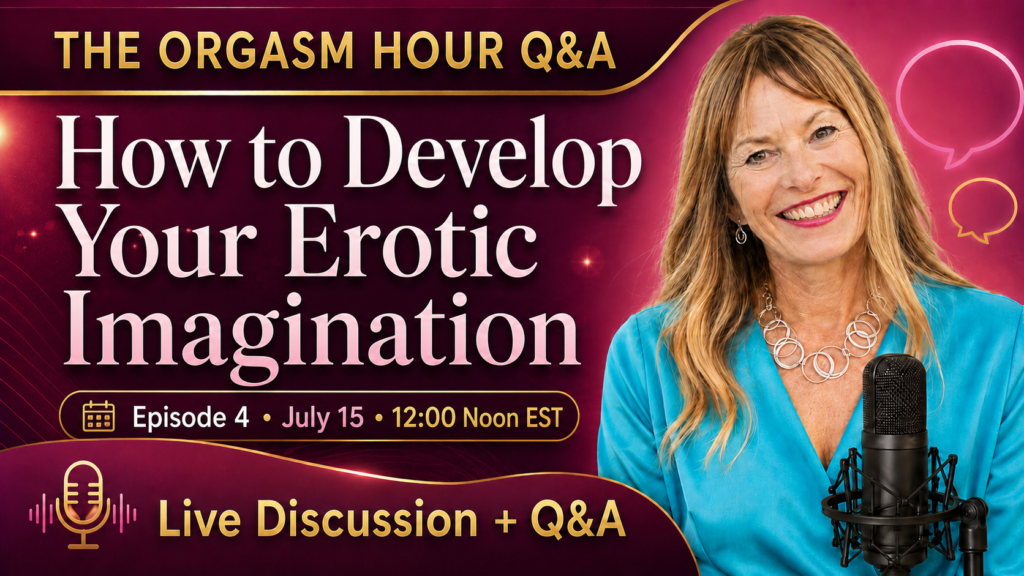
This blog post was adapted from Episode 4 of The Orgasm Hour. You can watch this episode at https://youtube.com/live/B25ld1l5da8.
Watch The Orgasm Hour Q&A on our YouTube channel, where Dr. Suzanne Mulvehill explores orgasm, sexual health, relationships, women’s health, culture, consciousness, and the historical forces that shape our intimate lives.
You can also catch every episode of The Orgasm Hour Q&A on 10 podcast platforms.
Subscribe to our YouTube channel so you do not miss an upcoming episode, sign up for our newsletter, and get updates on our training programs at www.femaleorgasmtraining.org and follow Dr. Suzanne Mulvehill on social media at @drsuzannemulvehill.
Educational disclaimer: This article is intended for general educational purposes and is not a substitute for individualized medical, psychological, or sexual health care. Seek professional guidance for persistent orgasm difficulty, sexual pain, trauma-related symptoms, medication concerns, or significant changes in sexual functioning.

You may also like

How to Learn to Orgasm in More Than One Way