

Hypnotic Induction as an Orgasmic Learning Pathway
Can hypnosis help women access orgasm in a completely different way?
Hypnosis has been studied and used therapeutically for decades. Historically, researchers explored its use for sexual concerns in both women and men. These concerns included orgasm difficulty, sexual pain, erectile problems, and anxiety that can interfere with sexual response.
More recently, however, researchers have begun examining a remarkable question:
Can a woman experience an orgasm through hypnotic suggestion without direct genital stimulation?
The emerging research suggests that this may be possible. As a result, hypnotic induction may offer another way to think about female orgasm, orgasmic learning, and the connection between the brain and body.
There Are More Than 70 Years of Research Saying Yes
Hypnosis has a substantial history as a treatment approach for women with orgasm difficulty. The earliest paper we identified was published in 1951, in the Journal of Hypnotism Vol. 1 No. 2. Numerous research papers examining hypnosis as a treatment for female orgasm difficulties and related sexual concerns followed, including:
- Hypnosis in Frigidity, 1963
- An Overview of Outcome on Frigidity: Treatment Effects and Effectiveness, 1976
- Hypnosis in the Treatment of Sexual Dysfunction, 1980
- Therapy of Vaginismus by Hypnotic Desensitization, 1980
- Use of Hypnosis in the Treatment of Psychogenic Sexual Dysfunctions, 1986
- Using Hypnosis in a case of Vaginismus: A Case Report. 2011
- Clinical Hypnosis and Female Sexual Dysfunction: A Case Report, 2019
Together, this research shows that hypnosis has been discussed in connection with sexual functioning for decades.
However, something interesting happened along the way.
How Hypnosis Dropped Out of the Treatment Literature
By 1983, hypnosis was recognized as a major treatment model for primary orgasmic dysfunction, which referred to a woman who had never experienced orgasm.
However, hypnosis largely disappeared from later reviews of treatments for female orgasm difficulties.
Later, hypnosis was also absent from Marchand’s 2020 review of psychological and behavioral treatments for female orgasmic disorder. Neither hypnosis, hypnotherapy, nor hypnotic induction appeared in the paper or its references. In addition, the literature search terms did not include terminology related to hypnosis.
Then, in 2025, hypnosis returned to the scientific conversation.
Research by Dr. Jim Pfaus and colleagues brought renewed attention to hypnotically induced orgasm. Their preliminary findings indicated that orgasm could occur through hypnotic induction without direct genital stimulation. Furthermore, researchers documented measurable physiological responses.
Therefore, hypnosis may represent one of several possible orgasmic learning pathways.
What Is Hypnosis?
The word hypnosis historically came from a term associated with sleep.
However, researchers eventually recognized that people experiencing hypnosis were not actually asleep.
Instead, hypnosis involves concentrated attention and prolonged absorption.
A contemporary definition describes hypnosis as a state of consciousness involving focused attention, reduced awareness of the surrounding environment, and an increased capacity to respond to suggestion.
A hypnotic induction is the procedure used to help someone enter that state.
During hypnosis, a practitioner may offer suggestions involving changes in:
- Perception
- Sensation
- Emotion
- Thought
- Imagination
- Behavior
People can also learn self-hypnosis, which involves using hypnotic procedures without another person directing the experience.
Hypnotherapy, meanwhile, refers to the therapeutic use of hypnosis to address a medical, psychological, behavioral, or emotional concern.
These distinctions are important. For example, watching a stage hypnosis performance is very different from participating in clinical hypnotherapy with a qualified professional.
Why Absorption Matters for Orgasm
One of the most important words in the definition of hypnosis is absorption.
Absorption is the ability to become deeply engaged in an experience. You may have entered an absorbed state while reading a compelling book, watching a film, listening to music, meditating, creating art, or becoming immersed in fantasy.
For many women, absorption is also important for orgasm.
Orgasm may become more difficult when the mind remains highly analytical or divided. A woman may be receiving pleasurable stimulation while simultaneously wondering:
“Am I taking too long?”
“Is my partner becoming frustrated?”
“Will I orgasm this time?”
“Does my body look attractive?”
“Am I doing this correctly?”
“Why am I not feeling more?”
As these thoughts accumulate, attention remains focused on evaluating the experience rather than becoming absorbed in it.
This is where hypnosis becomes particularly interesting.
Hypnosis intentionally develops focused attention while reducing awareness of peripheral distractions. Therefore, it may resemble some of the mental conditions that support orgasm.
Instead of trying to force orgasm through increasingly intense stimulation, hypnosis may help change how attention, imagination, sensation, and expectation are organized.
Orgasm Is Not Only a Genital Event
Sexual medicine has often approached orgasm through the lens of genital stimulation.
Clearly, genital stimulation is an important pathway to orgasm. However, it is not the only pathway documented in scientific literature.
Researchers have studied women who report orgasm through:
- Fantasy and imagery
- Hypnosis
- Breathwork
- Movement
- Pelvic floor activity
- Other forms of non-genital stimulation
In addition, brain imaging research has examined whether non-genitally stimulated orgasms activate patterns associated with orgasms involving genital stimulation.
This research expands the way we can think about female orgasm.
Orgasm is not simply something that happens in the genitals. Instead, it is a complex brain-and-body response involving sensation, attention, memory, imagination, nervous system activity, pelvic floor responses, and emotion.
It may also involve the capacity to move into an altered or deeply absorbed state.
Therefore, the existence of non-genitally stimulated orgasm raises an important therapeutic question:
Could learning to access an orgasmic state through one pathway make orgasm more accessible through another?
Emerging research suggests this possibility deserves further investigation.
For that reason, hypnosis may be an important orgasmic learning pathway to study.
Not Everyone Responds to Hypnosis Equally
People vary in hypnotizability, meaning their ability to experience suggested changes in perception, sensation, thought, emotion, physiology, or behavior.
Some people enter hypnotic states easily. Others may require practice, and some may respond only minimally.
This does not mean that people who respond less strongly have failed. Hypnotic responsiveness is an individual difference, not a measure of intelligence, openness, sexuality, or personal worth.
It also means we should not assume that everyone can listen to a recording and immediately experience an orgasm.
The women in the recent preliminary research were screened for responsiveness to hypnotic induction. That is an important limitation when considering how the results might apply to a broader population.
Future research needs to examine whether hypnotic responsiveness can be strengthened through practice and whether hypnosis can support sexual functioning even when it does not directly produce orgasm.
Hypnosis May Help in More Than One Way
The clinical value of hypnosis may not depend solely on producing an orgasm during a hypnotic session.
Hypnosis might support orgasmic learning by helping a person:
- Reduce distracting thoughts.
- Become absorbed in sensation.
- Develop erotic imagination.
- Change negative expectations.
- Reduce anticipatory anxiety.
- Increase awareness of subtle bodily signals.
- Rehearse communicating boundaries and desires.
- Create new associations with touch and pleasure.
- Address learned fear or shame connected to sexuality.
These are possibilities that require further research. They also suggest that the question should not be limited to, “Can hypnosis make someone orgasm?”
A broader question is:
“Can hypnosis help create the internal conditions in which orgasm becomes more accessible?”
The Difference Between Orgasmic Learning and Orgasmic Expecting
Many women enter sexual experiences expecting an immediate result.
They try a technique, a vibrator, a fantasy, a medication, a cannabis product, or a hypnotic recording and wait to see whether it produces an orgasm.
When it does not happen immediately, they become frustrated.
That frustration may activate more self-monitoring and pressure, making orgasm even less accessible.
This is orgasmic expecting.
Orgasmic learning is different.
Orgasmic learning recognizes that the nervous system may need repeated experiences of safety, absorption, sensation, imagination, and pleasure. The goal is not to command the body to produce an orgasm on demand. The goal is to help the body and brain develop the conditions in which the orgasmic response can emerge.
We do not expect to run a mile without training. We do not expect to play the piano after one lesson. Yet women are often expected to orgasm quickly, consistently, and through a narrow set of sexual activities without ever having been taught how their own orgasmic response works.
Hypnosis may be one tool for practicing attention and absorption rather than demanding an immediate outcome.
Exploring Hypnosis Safely
Someone interested in clinical hypnosis should look for a qualified practitioner with legitimate training in hypnosis and experience addressing sexual health concerns.
A responsible practitioner should be willing to discuss the limitations of the evidence, explain the treatment process, and coordinate with other healthcare professionals when needed.
Self-hypnosis or guided recordings may also help some people practice relaxation, imagery, and focused attention. Use them only in a safe environment, never while driving or doing anything that requires full alertness.
The initial goal does not need to be orgasm. It may simply be learning to remain present with the body without judgment.
Expanding the Boundaries of Sexual Medicine
Sexual medicine has historically focused heavily on genital anatomy and physical stimulation.
But what happens when an orgasmic learning pathway does not begin with the genitals?
Where do hypnosis, fantasy, breathwork, meditation, pelvic floor movement, non-genital stimulation, and altered states of consciousness belong?
These pathways have often existed at the edges of sexual medicine, separated into different professional and research fields.
Bringing them together does not mean abandoning conventional medical or psychological treatment. It means expanding the questions we are willing to ask.
Orgasm is a brain and body event. Its pathways may be physical, psychological, relational, imaginative, sensory, and neurological.
Hypnosis may be one way of accessing those interconnected systems.
Continue the Conversation
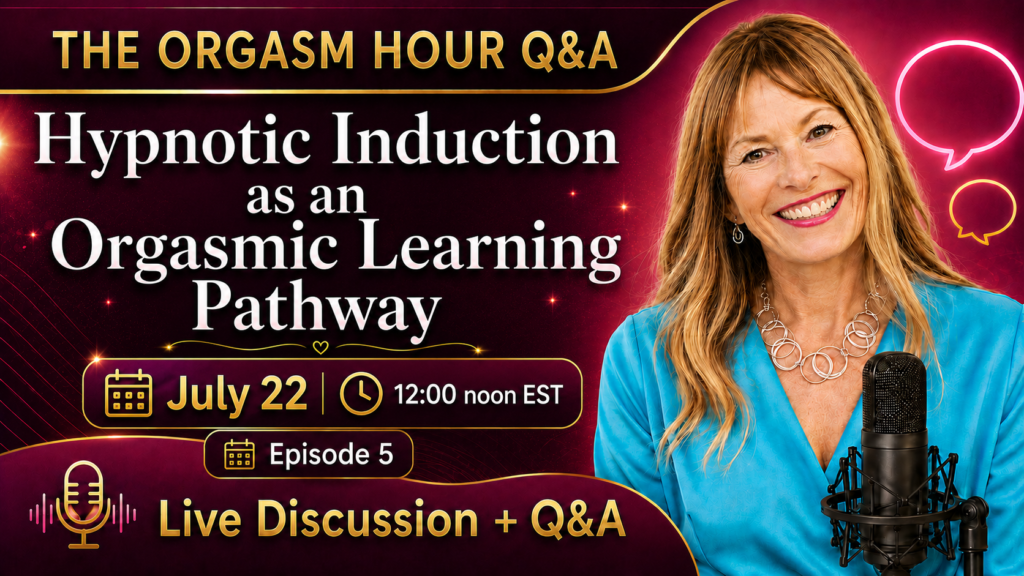
This blog post was adapted from Episode 5 of The Orgasm Hour Q&A on our YouTube channel, and can be found here https://youtube.com/live/eO_1lMzK-Gg
Dr. Suzanne Mulvehill explores orgasm, sexual health, relationships, women’s health, culture, consciousness, and the historical forces that shape our intimate lives.
You can also catch every episode of The Orgasm Hour Q&A on 10 podcast platforms.
Subscribe to our YouTube channel so you do not miss an upcoming episode, and follow Dr. Suzanne Mulvehill on social media at @drsuzannemulvehill.
Educational disclaimer: This article is intended for general educational purposes and is not a substitute for individualized medical, psychological, or sexual health care. Hypnosis and hypnotherapy should be provided by appropriately qualified professionals. Seek professional evaluation for persistent orgasm difficulty, sexual pain, trauma-related symptoms, medication concerns, or significant changes in sexual functioning.

You may also like

How to Learn to Orgasm in More Than One Way