

What If the Real Secret to Orgasm Isn’t What You Think?
Why can a woman feel sexually aroused, enjoy stimulation, and still struggle to reach orgasm?
For years, common advice has focused on increasing arousal, experimenting with stimulation, or finding techniques that produce stronger sensations. Yet many women describe becoming highly aroused without experiencing orgasm. Some reach a point where stimulation becomes uncomfortable, overwhelming, or even painful.
Research on sexual inhibition and orgasm may help explain why this happens.
During an episode of The Orgasm Hour, I explored this relationship through an analogy most people understand: learning to drive a car.
When we drive, we use an accelerator to move forward and a brake to slow down or stop. Sexual response involves a similar balance.
The accelerator represents sexual excitation, including arousal and pleasurable stimulation. The brake represents sexual inhibition, which can involve anxiety, fear, distraction, performance concerns, and other factors that interfere with sexual responsiveness.
Sometimes both are activated at once.
A woman may enjoy sexual stimulation while worrying about whether she will orgasm, how long she is taking, or whether her partner is becoming frustrated.
Understanding these processes may help explain why orgasm remains difficult for some women, even when they experience substantial sexual arousal.
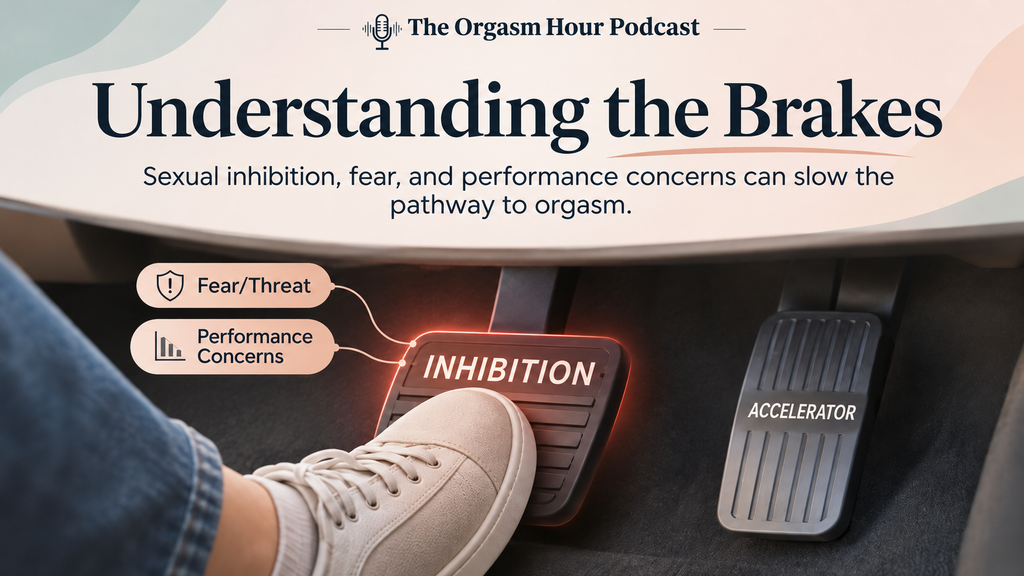
Understanding Sexual Inhibition and Orgasm: The Brakes and Accelerator
The Dual Control Model of sexual response describes two relatively independent systems: sexual excitation and sexual inhibition.
Sexual excitation increases responsiveness to sexual cues. These cues may include physical stimulation, erotic thoughts, emotional connection, or other experiences a person finds sexually meaningful.
Sexual inhibition can reduce responsiveness when concerns or competing demands become more prominent.
Both systems serve important functions. Inhibition can protect us from unwanted or unsafe sexual experiences.
Problems may arise when inhibitory responses become particularly sensitive or remain active during wanted sexual activity.
Imagine pressing the accelerator while keeping one foot on the brake.
The car may move forward, but the brakes interfere with its movement.
For some women, sexual arousal develops while concerns about performance, body image, or previous sexual experiences continue to interfere with their response.
Research suggests that these inhibitory processes deserve greater attention in understanding female orgasm difficulty.
Fear of Sexual Performance Failure and Orgasm Difficulty
A 2018 study by Tavares et al., published in The Journal of Sexual Medicine, examined sexual inhibition and orgasm problems among 1,002 women aged 18 to 72.
Participants completed questionnaires examining psychological characteristics, sexual beliefs, sexual excitation, inhibition, and orgasm occurrence.
The researchers found that sexual inhibition associated with fear of performance failure was an important vulnerability factor for orgasm difficulty.
Concerns about the consequences of sexual performance and beliefs about body image were also relevant.
Consider a woman who begins thinking:
Am I taking too long?
Will I be able to orgasm this time?
What will my partner think if I don’t?
These thoughts can shift attention away from pleasurable sensations and toward evaluating sexual performance.
The study also examined orgasm occurrence across different sexual activities.
Clitoral-focused masturbation was associated with the highest likelihood of orgasm. Penile-vaginal intercourse accompanied by additional clitoral stimulation was another important pathway.
This finding is particularly relevant to women who feel embarrassed about needing a vibrator or additional clitoral stimulation during partnered sex.
In the live episode, I discussed a Reddit post from a man who was frustrated because his partner needed a vibrator to orgasm during intercourse.
The research provides a useful perspective: additional clitoral stimulation is a common and valid part of women’s orgasmic experiences.
The researchers also examined how sexual inhibition interacted with sexual activity. Greater sexual activity was associated with more frequent orgasm when inhibition was lower, while higher inhibition weakened that relationship.
These findings suggest that sexual frequency alone cannot explain orgasm difficulty.
The study’s authors recommended greater clinical attention to processes that inhibit orgasmic response.
For women who feel aroused but struggle to reach orgasm, understanding what happens between arousal and orgasm may offer a useful starting point.
Why Safety Is the Foundation of Female Orgasm Response
To understand how inhibition may interfere with orgasm, I want to introduce the Hierarchy of Female Orgasm Response.
This is a proposed model I developed to organize the conditions that may support orgasmic accessibility.
The hierarchy includes five phases:
Safety → State Transition → Absorption → Sensory Amplification → Orgasmic Release
Each phase represents a different aspect of the process through which orgasm may become accessible.
Safety forms the foundation. It includes physical safety, emotional security, and the ability to engage in sexual experiences without persistent fear or unwanted pressure.
State transition describes a shift away from ordinary waking awareness and everyday cognitive activity.
Absorption involves becoming deeply engaged in an experience, with attention increasingly focused on sensations or imagery.
Sensory amplification describes the heightened awareness and intensity of pleasurable sensations.
Orgasmic release represents the culmination of these interacting processes.
You can explore the model through the Female Orgasm Training Institute’s resources for professionals.
During the live episode, I gave a simple example of how safety can influence sexual experience.
Imagine trying to become sexually absorbed while worrying that a neighbor might hear you through an open window or that someone might unexpectedly knock on your door.
Even when you consciously tell yourself everything is fine, part of your attention may remain focused on the environment.
Concerns about privacy, discomfort, or unwanted interruptions can make it difficult to become fully immersed in pleasurable sensations.
This is one reason I place safety at the foundation of the hierarchy.
The model requires further scientific testing. It offers a framework for investigating relationships among nervous system regulation, attention, and orgasm.
Why Sexual Inhibition May Matter More Than Excitation
A second study helps us understand the importance of the braking system.
In Predicting Sexual Problems in Women: The Relevance of Sexual Excitation and Sexual Inhibition, Sanders, Graham, and Milhausen examined data from 540 heterosexual women.
Published in Archives of Sexual Behavior, the study investigated sexual excitation and inhibition in relation to sexual interest, arousal difficulties, and orgasm problems.
The researchers identified two particularly important inhibitory factors.
The first was arousal contingency, which describes how easily sexual arousal can be disrupted by circumstances or competing experiences.
The second was concerns about sexual function, including worries about sexual performance and responsiveness.
These inhibitory factors were among the strongest statistical predictors of current and lifetime sexual difficulties.
The researchers found comparatively little evidence that low sexual excitation predicted the sexual problems they examined.
This finding is especially interesting when we consider women who describe becoming aroused and then suddenly losing the sensation.
A woman may initially enjoy stimulation but begin to feel numb or disconnected.
She may wonder why the pleasure disappeared or whether it will return.
That concern can introduce further distraction and make the experience increasingly difficult.
During the live episode, I emphasized the importance of recognizing these changes and communicating them.
If stimulation becomes painful, overwhelming, or uncomfortable, a woman can ask her partner to stop or change what is happening.
I like to think of communication as the steering wheel.
It gives a woman a way to direct the experience, communicate what she needs, and maintain control over her participation.
Listening to the body’s signals and responding to them can support a greater sense of agency and safety.
Research on sexual inhibition and orgasm suggests that understanding these changes may be an important part of addressing orgasm difficulty.
When the Accelerator Becomes the Brake
One of the most interesting aspects of sexual response is that the same experience may be pleasurable under one set of circumstances and uncomfortable under another.
Dr. Michael Perelman’s Sexual Tipping Point® Model helps explain this possibility.
In his 2018 article, Why the Sexual Tipping Point Is a “Variable Switch Model,” Perelman describes sexual response as an interaction between excitatory and inhibitory influences.
The effects of particular influences can vary depending on the individual and circumstances.
During the live episode, I discussed examples from women describing their experiences in online orgasm communities.
Some reported becoming highly sensitive during stimulation and needing to stop.
Others described sensations becoming painful, overwhelming, or uncomfortable just as they felt they might be approaching orgasm.
One woman described experiencing sensory overload that prevented her from reaching orgasm.
These personal reports are not controlled scientific evidence, but they illustrate experiences that deserve further investigation.
A sensation that initially increases arousal may eventually become unpleasant.
The woman may begin anticipating discomfort, which can increase inhibition and change her response to continued stimulation.
This helps explain why simply increasing stimulation may be ineffective for some women.
Learning to recognize when pleasure is changing, adjusting the experience, and communicating with a partner may be important aspects of sexual responsiveness.
The driving analogy becomes useful again.
Learning to drive involves recognizing road conditions, adjusting speed, and responding appropriately when something changes.
Understanding sexual response may involve developing a similar awareness of what supports pleasure and what interferes with it.
PTSD, Sexual Trauma, and the Nervous System
Some inhibitory responses develop through everyday experiences, beliefs, or concerns about sexual performance.
Others may be associated with trauma.
A 2015 review by Yehuda et al., titled PTSD and Sexual Dysfunction in Men and Women, examined the relationship between post-traumatic stress disorder and sexual functioning.
The authors discussed how PTSD can affect sexual experiences through hypervigilance, intrusive memories, emotional numbing, and difficulty regulating physiological arousal.
Their review describes competing processes involving sexual arousal and responses associated with fear or threat.
This is particularly relevant to the braking and accelerating analogy.
Sexual activity can involve increased heart rate, changes in breathing, and heightened bodily sensations.
For some trauma survivors, aspects of physiological arousal may become associated with fear or distress.
These responses can interfere with sexual pleasure, even when the person consciously wants the experience.
During my dissertation research, I interviewed a woman who had experienced sexual assault during adolescence.
She described being unable to orgasm during masturbation or partnered sexual activity for years afterward.
She later reported experiencing her first orgasm after using cannabis with a partner she loved and subsequently married.
Her experience was significant, but it represents an individual account rather than evidence that cannabis will produce the same outcome for other women.
I also discussed my own experience of spending approximately 30 years trying to understand and overcome orgasm difficulty.
For me, learning to become comfortable with the sensations associated with orgasm involved considerable trial and error.
I had spent much of my life relying on control, planning, and intellectual effort. Becoming absorbed in a sexual experience required learning a different way of attending to my body.
These experiences contributed to my interest in researching orgasmic accessibility.
Trauma-related sexual difficulties deserve careful, individualized assessment. Women may benefit from trauma-informed care, and no one should feel pressured to continue sexual activity that causes distress or discomfort.
Cannabis, the Amygdala, and Threat Processing
The relationship between trauma, fear, and sexual response raises questions about how the brain processes threatening information.
One brain structure involved in this process is the amygdala. It helps detect emotionally significant information, including potential threats, and works with other brain regions involved in emotional regulation.
Researchers have investigated whether cannabinoids influence activity within these networks.
In a 2020 study by Rabinak et al., titled Cannabinoid Modulation of Corticolimbic Activation to Threat in Trauma-Exposed Adults, researchers examined how THC affects the brain’s response to threat.
The randomized, double-blind, placebo-controlled study included 71 adults across three groups: healthy controls without trauma exposure, trauma-exposed adults without PTSD, and trauma-exposed adults with PTSD.
Participants received THC or placebo before completing a threat-processing task during functional magnetic resonance imaging (fMRI).
Among participants with PTSD, THC was associated with reduced threat-related amygdala activity, increased activation in the medial prefrontal cortex, and changes in connectivity between these brain regions.
The researchers described these findings as preliminary. Their results suggest that THC may influence neural processes involved in detecting and responding to threats.
These findings also raise questions about the relationship between nervous system regulation and sexual response. The study did not investigate female orgasm, so its results cannot establish whether cannabis improves orgasmic functioning.
Cannabis can also cause anxiety, impairment, and other unwanted effects. Individual responses vary, and the potential benefits and risks require careful consideration.
Further research is needed to understand whether changes in threat processing influence the orgasm-related experiences some women report with cannabis.
Orgasmic Learning and the Sexual Tipping Point
My 2026 paper, Orgasmic Learning as a Treatment Framework for Female Orgasmic Disorder/Difficulty: A Review Using Perelman’s Sexual Tipping Point® Model, brings together research spanning more than five decades.
Published in Current Sexual Health Reports, the review examines pathways through which women have reported or demonstrated increased orgasmic accessibility.
These include cannabis-associated experiences, fantasy and imagery, hypnotic induction, pelvic floor and somatic practices, breath-based approaches, and certain historically studied altered-state interventions.
The evidence varies considerably across these pathways. Some findings come from small studies, clinical reports, or individual experiences, and they should not all be interpreted as equally established treatments.
A recurring theme in the research is the potential importance of changes in attention, inhibition, sensory awareness, and conscious state.
Orgasmic Learning proposes that some women may benefit from learning to access conditions that make orgasmic response more available.
Consider how we learn to drive.
Initially, every movement requires attention. We think about the accelerator, brakes, steering wheel, mirrors, and surrounding traffic.
With experience, many of these processes become more coordinated.
The nervous system develops familiarity with the activity.
My proposed framework considers whether aspects of orgasmic accessibility may also be influenced by learning.
For women who experience orgasm difficulty, this may involve recognizing conditions that support safety, becoming more comfortable with bodily sensations, and developing the ability to remain absorbed in pleasurable experiences.
The framework remains a scientific proposal. Further clinical research is necessary to establish which interventions are effective, for whom, and under what circumstances.
Can the Nervous System Learn Through Experience?
The possibility of learning new responses is supported by the broader neuroscience of neuroplasticity.
In Principles of Experience-Dependent Neural Plasticity: Implications for Rehabilitation After Brain Damage, Kleim and Jones (2008) reviewed principles describing how experience and repeated activity can influence neural organization and function.
Neuroplasticity is involved in learning and adaptation throughout life.
Experiences can strengthen certain patterns of neural activity, while changes in behavior and practice can influence how responses develop.
This research was primarily concerned with neural plasticity and rehabilitation rather than female orgasm.
Its relevance to Orgasmic Learning is therefore conceptual.
It provides a scientific basis for investigating whether repeated experiences involving attention, sensory processing, and regulation may influence orgasmic accessibility.
This possibility also raises another question: how do women recognize what is happening inside their bodies as these experiences unfold?
Interoceptive Awareness and Female Orgasm
One of the final studies I discussed during the live episode examined interoception.
Interoception refers to our ability to perceive and interpret internal bodily signals.
These may include breathing, heartbeat, muscle tension, comfort, discomfort, and other physical sensations.
In Interoceptive Awareness and Female Orgasm Frequency and Satisfaction, Dixon et al. (2024) investigated relationships between body awareness and orgasm among 318 women.
Published in Brain Sciences, the study examined orgasm frequency and satisfaction during solitary and partnered sexual experiences.
Three findings were particularly interesting.
Noticing bodily sensations predicted orgasm frequency during both solitary and partnered sexual experiences.
Attention regulation predicted greater orgasm frequency and satisfaction during solitary sexual activity, but not partnered activity.
Trusting one’s body predicted orgasm satisfaction in both contexts, although it did not predict orgasm frequency.
These findings suggest that different aspects of body awareness may relate to different dimensions of orgasmic experience.
During the live episode, I discussed how interoceptive awareness might help women recognize changes in sensation.
A woman may notice when stimulation becomes uncomfortable, when she begins feeling disconnected, or when her body needs a pause.
Recognizing those signals creates an opportunity to respond.
She can communicate with her partner, change the stimulation, or stop the activity.
In the driving analogy, interoceptive awareness helps us recognize what is happening as we move along the road.
Attention regulation helps us remain engaged with the experience, while body trust may influence how comfortable we feel responding to internal signals.
The study was observational, so it cannot establish that improving interoceptive awareness will directly increase orgasm frequency or satisfaction.
Nevertheless, it offers a valuable direction for future research on female orgasmic functioning.
Learning to Understand Your Own Sexual Response
The research discussed in this episode offers several important insights into female orgasm difficulty.
Sexual inhibition can interfere with orgasm even when a woman experiences substantial arousal. Performance concerns, fear, distraction, and previous experiences may influence how the nervous system responds to stimulation.
Pleasurable sensations can also become uncomfortable or overwhelming. Recognizing these changes allows a woman to communicate her needs, adjust stimulation, or stop when something no longer feels right.
Research on interoception adds another dimension. Noticing sensations and trusting the body are associated with different aspects of orgasmic functioning.
Together, these findings support further investigation into the relationship between nervous system regulation, attention, safety, and orgasmic accessibility.
The Hierarchy of Female Orgasm Response offers a proposed way to organize these processes, beginning with safety and moving through state transition, absorption, sensory amplification, and orgasmic release.
For women experiencing orgasm difficulty, understanding sexual inhibition and orgasm may help them recognize patterns in their own sexual responses.
The driving analogy offers a useful way to think about this process.
Learning to drive involves becoming familiar with the accelerator, brakes, and steering wheel. Over time, we learn to recognize changing conditions and respond to them.
Understanding orgasm may involve developing similar awareness of the conditions that support pleasure and those that interrupt it.
What would change if women learned to recognize their sexual brakes as carefully as they have been taught to increase their arousal?
In the next episode of The Orgasm Hour, we’ll explore emotional abuse, sexual pressure, and coercive control, including how a partner’s expectations may affect a woman’s sense of safety and sexual responsiveness.
For additional information, explore the Female Orgasm Training Institute, learn about the Hierarchy of Female Orgasm Response, and visit the Female Orgasm Research Institute for scientific research on female orgasm.
References
Dixon, E., Poerio, G. L., Rieger, G., & Klabunde, M. (2024). Interoceptive awareness and female orgasm frequency and satisfaction. Brain Sciences, 14(12), 1236. https://doi.org/10.3390/brainsci14121236
Kleim, J. A., & Jones, T. A. (2008). Principles of experience-dependent neural plasticity: Implications for rehabilitation after brain damage. Journal of Speech, Language, and Hearing Research. https://doi.org/10.1044/1092-4388(2008/018)
Mulvehill, S. (2026). Orgasmic learning as a treatment framework for female orgasmic disorder/difficulty: A review using Perelman’s Sexual Tipping Point® Model. Current Sexual Health Reports, 18, Article 16. https://doi.org/10.1007/s11930-026-00428-w
Perelman, M. A. (2018). Why the Sexual Tipping Point® is a “variable switch model.” Current Sexual Health Reports. https://www.springermedizin.de/why-the-sexual-tipping-point-is-a-variable-switch-model/15711756
Rabinak, C. A., Blanchette, A., Zabik, N. L., Peters, C., Marusak, H. A., Iadipaolo, A., & Elrahal, F. (2020). Cannabinoid modulation of corticolimbic activation to threat in trauma-exposed adults: A preliminary study. Psychopharmacology, 237(6), 1813–1826. https://doi.org/10.1007/s00213-020-05499-8
Sanders, S. A., Graham, C. A., & Milhausen, R. R. (2008). Predicting sexual problems in women: The relevance of sexual excitation and sexual inhibition. Archives of Sexual Behavior. https://doi.org/10.1007/s10508-007-9235-7
Tavares, I. M., Laan, E. T. M., & Nobre, P. J. (2018). Sexual inhibition is a vulnerability factor for orgasm problems in women. The Journal of Sexual Medicine, 15(3), 361–372. https://pubmed.ncbi.nlm.nih.gov/29396021/
Yehuda, R., Lehrner, A., & Rosenbaum, T. Y. (2015). PTSD and sexual dysfunction in men and women. The Journal of Sexual Medicine. https://academic.oup.com/jsm/article-abstract/12/5/1107/6980091
Medical disclaimer: This article is intended for educational purposes and does not provide medical advice or establish an individualized treatment plan. Persistent orgasm difficulty may involve medical, psychological, relational, and other factors. Women experiencing sexual pain, trauma-related symptoms, or ongoing orgasm difficulty should consult an appropriately qualified healthcare professional. Cannabis is not an FDA-approved treatment for female orgasmic disorder.

You may also like

The Price of an Orgasm: What Are Women Willing to Risk?