
What Did Saint Augustine Learn About Desire at Home?
We often encounter Saint Augustine as one of the most influential Christian thinkers on sexuality, lust, chastity, and the control of desire.
But before Augustine became a theologian writing about sexual desire, he was a child watching a marriage.
And that marriage deserves our attention.
Augustine’s mother was Monica—later Saint Monica. His father, Patricius, was a man Augustine described as intensely hot-tempered and sexually unfaithful.
In Confessions, Augustine describes how Monica learned to live with her husband’s anger. She did not confront him while he was enraged. She waited until his anger subsided before addressing what had happened.
Augustine also tells us that Monica knew other wives whose faces showed evidence of being beaten by their husbands.
He does not tell us that Patricius beat Monica, and we should not claim that he did.
However, Augustine grew up in a world where male anger, marital inequality, sexual infidelity, and violence against wives were realities. Inside his own household, he watched a mother adapt herself to an unpredictable and angry husband while tolerating his sexual infidelity.
Children learn about relationships before they have language for what they are learning.
They watch and absorb. In the process, they begin learning what men do, what women endure, what sexuality means, what marriage requires, what desire permits, and what happens when desire escapes its prescribed boundaries.
My interpretation is that this had to matter.
Not in the simplistic sense that one childhood experience “caused” Augustine’s views on sexuality, but in the deeper developmental sense that watching his parents’ marriage gave him an early template for desire, power, fidelity, anger, gender, and control.
When we look at Augustine’s adult life, those themes do not disappear.
Instead, they appear repeatedly.
Saint Augustine’s Struggle With Sexual Desire
Augustine later wrote extraordinarily candidly about his own difficulty governing sexual desire.
Before his conversion, he had sexual relationships, fathered a son, and lived for many years with a woman whose name history has not preserved. In Confessions, he repeatedly returns to his struggle between sexual desire and his aspiration toward chastity.
His famous prayer captures the conflict:
“Grant me chastity and continence, but not yet.”
Eventually, Augustine’s thinking about desire became much larger than his personal struggle.
Sexual desire—particularly what Christian theology would call concupiscence—became deeply entangled in his thinking about humanity after the Fall. The unruliness of sexual arousal mattered because the body did not simply obey conscious human will.
Over time, Augustine’s ideas profoundly influenced Western Christianity.
That is where I believe we need to look more closely.
Did Augustine Theologize His Conflict With Desire?
What if Augustine did not fully resolve his conflict with desire so much as theologize it?
That is my interpretation.
He grew up watching a sexually unfaithful father and a mother whose virtue was defined partly by endurance, restraint, fidelity, and accommodation to male anger. Later, Augustine experienced his own sexuality as unruly and difficult to control.
Rather than arriving at a framework that treated desire as something to understand, integrate, or learn from, he became one of the most influential architects of a religious tradition in which desire itself became something to discipline, restrain, and master.
In my view, that matters.
When a person with unresolved conflict around sexuality becomes a moral authority on sexuality, the personal can become cultural.
Augustine’s ideas did not remain his private struggle.
They became theology, and theology helped shape social structure.
Within those developing frameworks, women’s bodies, women’s sexuality, and women’s perceived power to arouse desire could increasingly be interpreted through male concerns about temptation, chastity, continence, and control.
I see that as a form of displacement.
Instead of asking, “What is happening inside me when I experience desire?”
the question can become:
“What or who is causing me to desire?”
Historically, women have often paid the price for that shift.
From Personal Sexual Conflict to Cultural Authority
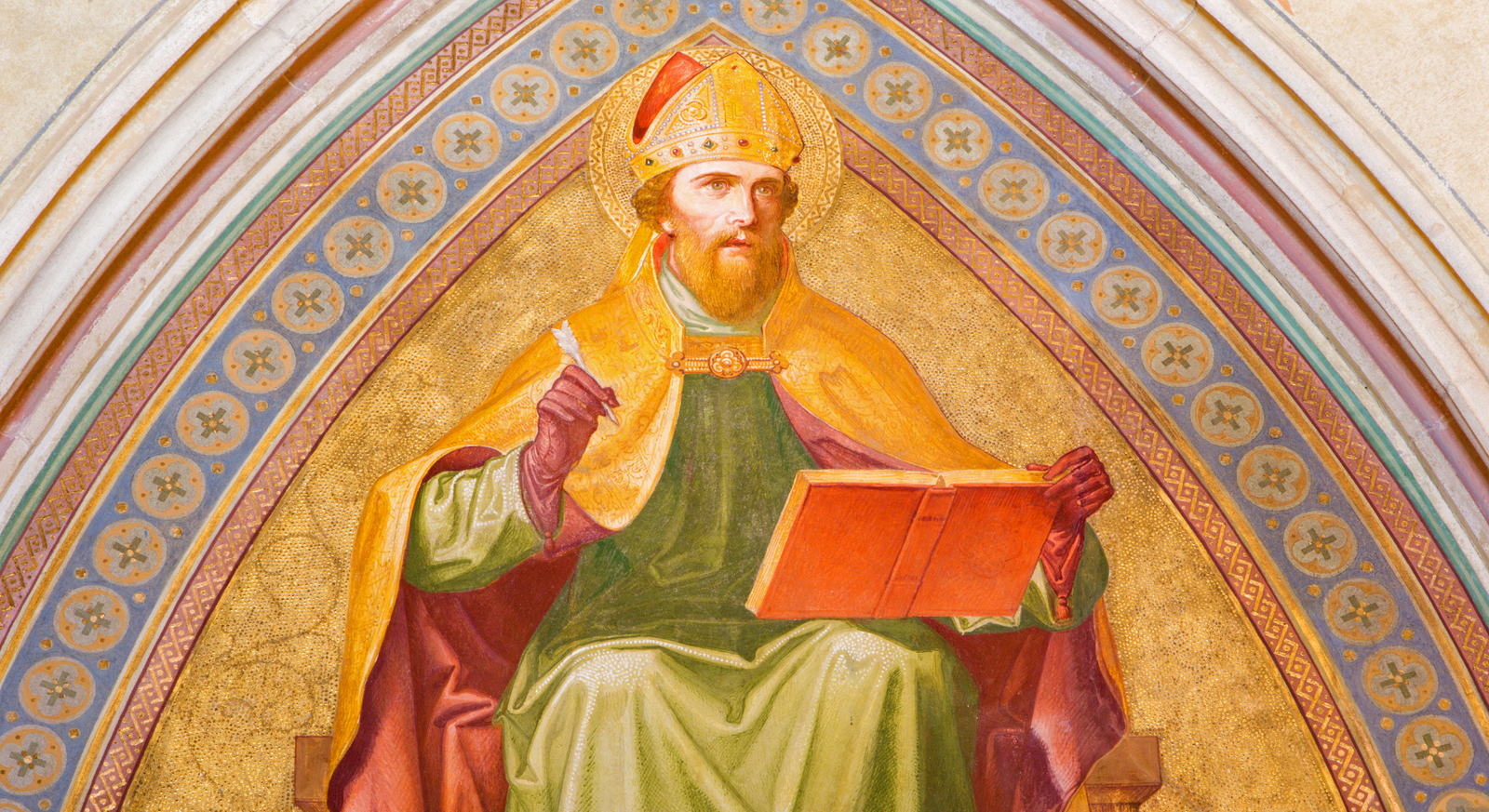
That is why an image I encountered in a church near Pompeii struck me so strongly.
There was Augustine, represented as an authority on chastity, in a Christian sacred space built into a landscape already layered with pre-Christian religious meaning.
For me, the symbolism was difficult to miss.
Christianity did not simply introduce a new religion. It also introduced a profoundly different framework for interpreting the body, sexuality, desire, chastity, sin, and women.
Augustine became one of the people who helped give that framework intellectual authority.
This question of how religious and cultural interpretations of sexuality become authoritative also appears in the history of Christianity and sexual dysfunction, where inherited ideas about desire, morality, and sexual restraint can eventually influence how later cultures understand sexual function itself.
Then there is one of the strangest modern echoes of all.
Saint Augustine and Sex and Love Addicts Anonymous
Sex and Love Addicts Anonymous is formally called The Augustine Fellowship.
The fellowship was named after Augustine precisely because its founders recognized in his writings a struggle with sex, love, and desire that they felt resembled their own.
That is extraordinary.
The man who became one of Christianity’s most influential voices on the need to govern sexual desire later became the symbolic namesake of a modern fellowship devoted to controlling problematic sexual and romantic behavior.
There is a profound irony here.
What if part of the modern struggle around sexuality is not simply desire itself?
What if part of the struggle is also the inheritance of a cultural system that taught people to fear, suppress, moralize, and battle desire?
In other words:
What if the framework used to solve the problem is partly descended from the framework that helped create the shame around the problem?
That does not mean Christianity causes compulsive sexual behavior.
Nor does it mean Augustine single-handedly created Western sexual shame. Likewise, it does not mean every person who struggles with sexuality is struggling because of religion.
However, it does mean we should examine the genealogy of our ideas.
From Sacred Desire to Controlled Desire
More than eight centuries before Augustine wrote his Confessions, Greek artists represented Himeros—Desire itself—as a divine being accompanying Aphrodite.
Desire had a name and a body.
Desire could stand beside a goddess.
In another ancient Greek image, Eros approaches a bride as she enters marriage.
Centuries later, Augustine became enormously influential in a Christian tradition increasingly concerned with disciplining sexual appetite.
That represents an extraordinary cultural journey:
from personifying desire
to governing desire
to pathologizing certain forms of desire
to building recovery systems around controlling it.
This does not mean ancient Greek sexuality should be romanticized as universally liberated or healthy. Ancient societies had their own restrictions, hierarchies, inequalities, and sexual norms.
Instead, the contrast raises a larger question about how cultures construct the meaning of desire.
And behind one of the most influential thinkers in that transformation was a boy watching his mother and father.
So perhaps when we study the history of sexuality, we need to ask not only what our great thinkers thought about desire.
We should also ask:
What taught them to think about desire that way?
And perhaps an even more uncomfortable question:
What happens when one person’s unresolved struggle with sexuality becomes everybody else’s moral framework?