Why Is the Catholic Church Wary of AI?
Pope Leo XIV has made artificial intelligence one of the defining issues of his papacy.
In his 2026 encyclical Magnifica Humanitas, he devotes substantial attention to AI, emphasizing human dignity, freedom, conscience, and the need for human intelligence to remain responsible for determining the use and limits of artificial intelligence. The Vatican has also established an Inter-Dicasterial Commission on Artificial Intelligence involving, among others, the Dicasteries for the Doctrine of the Faith, Culture and Education, and Communication.
Those concerns deserve to be taken seriously. AI poses legitimate questions about misinformation, privacy, employment, human relationships, agency, and power.
But standing in Athens recently, I found myself wondering about another possibility.
Could AI also threaten something the Catholic Church has possessed for centuries—extraordinary institutional authority over religious knowledge and its interpretation?
I am not suggesting that Pope Leo XIV has said this. He hasn’t.
I’m asking a different question:
Does AI change the conditions that have historically helped sustain religious authority?
Because we’ve seen disruptive technologies change those conditions before.
The Printing Press Changed What People Could Read—and Whose Ideas Could Reach Them
I recently learned something I had never really understood about Martin Luther.
Martin Luther was a Catholic priest, monk, and professor of theology who challenged the practices and authority of the Catholic Church in the early 1500s.
In 1517, he circulated his famous Ninety-five Theses.
Among the practices Luther attacked was the promotion of indulgences.
When I learned what indulgences were, my reaction was essentially: You could buy a reduction in punishment for sin?
The history is a little more complicated.
Official Catholic theology did not teach that someone could simply purchase God’s forgiveness. An indulgence concerned what Catholicism calls the temporal punishment remaining after the guilt of a sin had already been forgiven.
By Luther’s time, indulgences had become entangled with fundraising. Their aggressive promotion in exchange for financial contributions became one of the abuses Luther attacked.
Here’s what fascinates me.
Critics of the Church had existed before Luther. What had changed was the technology.
The printing press allowed Luther’s arguments to be reproduced and distributed throughout Europe with a speed and reach that previously would have been impossible.
The Church could condemn him. Pope Leo X eventually excommunicated him in 1521.
But it could not stop his ideas from circulating.
As a result, Luther’s writings became an accelerant for the Protestant Reformation, which fractured Western Christianity and ended Catholic religious authority across large parts of Europe.
The printing press didn’t merely make more information available.
It gave competing ideas a distribution system.
The Catholic Church responded to this new information environment not only by using printing itself, but also through mechanisms of censorship and eventually the Index of Forbidden Books. Remarkably, the Vatican did not abolish the Index as ecclesiastical law until 1966.
The Telescope Changed What Humans Could See
Then came another technology: the telescope.
In the early 1600s, Galileo Galilei used this relatively new instrument to observe the heavens in ways humans had never been able to before.
Among other observations, he saw moons orbiting Jupiter and observed the phases of Venus.
These discoveries presented serious problems for the traditional geocentric conception of the heavens.
Galileo defended the Copernican proposition that Earth moves around the Sun.
Galileo defended the Copernican proposition that Earth moves around the Sun. In 1633, the Roman Inquisition tried him for his defense of heliocentrism in violation of Church restrictions. He was forced to recant and spent the remainder of his life under house arrest.
Today we know Galileo was correct about the central issue:
Earth is not stationary at the center of the universe. It rotates on its axis and travels around the Sun.
The telescope did something extraordinary.
It allowed humans to see evidence that challenged an established interpretation of reality.
And I began seeing a pattern.
The printing press expanded what people could read.
The telescope expanded what humans could see.
Then came the internet.
The Internet Changed What People Could Access and Communicate
Interestingly, the Catholic Church did not simply oppose the internet.
It recognized its power.
In 2002, Pope John Paul II described the internet as a new “forum” and explicitly encouraged the Church to enter cyberspace and use its potential to proclaim the Gospel. A Vatican document from the same year described the Church’s approach to communications technology as “fundamentally positive.”
The Church understood that it needed to be there.
Today, the Vatican operates across websites, news, publishing, video, radio, social media and other digital channels.
That tells me something important.
The Church understands that ideas survive because they are communicated.
But AI changes something again.
Anyone with a phone can ask, compare, investigate, connect, challenge and question with the tap of a button, virtually anywhere, 24 hours a day.
The printing press expanded what people could read.
The telescope expanded what humans could see.
The internet expanded what people could access and communicate.
Artificial intelligence is expanding what people can know—and how quickly they can interrogate what they have been told.
That brings me to five reasons I think AI may present a particular challenge to religious authority.
1. AI Weakens Institutional Control Over Knowledge
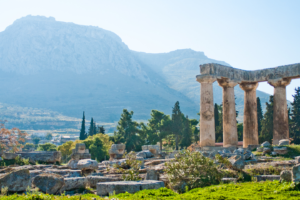
Standing in Athens, I learned something I never knew.
In 529 CE, Emperor Justinian acted against the remaining non-Christian philosophical teaching tradition in Athens.
This was the intellectual world descended from Plato, Aristotle and generations of philosophers asking questions about reality, nature, ethics, mathematics, astronomy, metaphysics, the soul, the gods and human existence.
Greek philosophy didn’t disappear. Far from it. Christian thinkers would incorporate enormous amounts of Greek philosophy into Christian intellectual traditions.
Nevertheless, something profound had changed.
Independent non-Christian philosophical institutions could no longer operate in Athens as they once had.
Political and religious authority increasingly defined the institutional boundaries within which knowledge could be taught.
AI moves in the opposite direction.
Standing in Athens with a phone, I can ask:
What existed before Christianity?
When did this doctrine develop?
How did Christian sexual morality evolve?
What do historians and archaeologists say happened?
How did the people standing on this exact ground 2,500 years ago understand their world?
Are there other interpretations of what happened here?
From there, I can ask another question—and another.
That changes who controls the questions.
More importantly, it changes what people can know without first going through an institution that determines how that information will be presented or interpreted.
2. AI Makes Religious Claims Easier to Compare, Question, and Discredit
Walking through the Acropolis Museum raised another question for me.
Ancient religions contain extraordinary stories.
Athena emerges fully formed from Zeus’s head. Helen emerges from an egg. Christianity tells us that Jesus was conceived by a virgin.
AI makes it remarkably easy to place these claims beside one another and investigate them historically.
Someone can ask:
Why are Athena emerging from Zeus’s head and Helen emerging from an egg called mythology, while one of the world’s largest religious traditions was built around belief in the virgin conception of Jesus?
That doesn’t prove Christianity false.
However, AI makes it extraordinarily easy to investigate the question.
We can examine ancient texts, archaeology, historical context, competing traditions, theological disputes, and the development of doctrines over time.
For some people, that process may discredit particular religious claims if they conclude that the evidence, history, or competing explanations do not support what they were taught to accept.
I know something about questioning inherited religion personally.
About 30 years ago, I left the Catholic Church after the Pope once again asserted Catholicism’s unique supremacy.
I called the church and essentially said:
Take me off your list. I don’t want to belong to something that believes it is better than everybody else.
I told my children that if they wanted to continue their religious classes, they could. If they didn’t, they didn’t have to.
That was the end of Catholicism for me.
More recently, my granddaughter was going to be baptized. I told my daughter I would not attend because I don’t believe children are born in sin.
Her reaction surprised me:
“Wow. I didn’t know that.”
That stayed with me.
How many beliefs do we continue through rituals and traditions without ever understanding what those rituals actually mean?
Now someone can ask AI:
Why are babies baptized?
Where did original sin come from?
When did Christians begin teaching it?
Do all Christians believe it?
What did earlier cultures believe about newborn children?
Once someone understands a tradition, that person can decide whether to pass it to another generation.
3. AI Reduces Dependence on Religious Authorities as Interpreters
For centuries, religious institutions played an enormous role in interpreting Scripture and explaining its meaning.
The printing press weakened that dependence, while the internet weakened it further.
AI changes it again.
People can investigate textual history, translation disputes, archaeology, theological disagreements, historical context, and competing interpretations without beginning with the explanation of a priest, pastor, bishop or other religious authority.
Instead of asking only:
“What am I supposed to believe?”
we can ask:
“Where did this belief come from?”
And then:
“Is it true?”
Those are fundamentally different questions.
This matters particularly to me because of my work as a clinical sexologist.
My own experience with orgasm difficulty led me to investigate the cultural suppression of sexual desire and the ways religious teachings can become embedded far beyond church walls.
Christian sexual morality has profoundly influenced Western culture. Its influence has reached families, schools, laws, and cultural ideas about modesty, masturbation, virginity, desire, female sexuality and what women learn to believe about their bodies.
A person doesn’t have to attend church for those ideas to reach them.
They can become embedded in the culture.
AI makes it dramatically easier to ask:
Where did these ideas come from?
4. AI Makes Forgotten Histories Easier to Recover
I experienced this recently while traveling through Switzerland.
I stayed with two different friends in mountain villages. Neither knew that people accused of witchcraft had been prosecuted and executed close to where they lived.
All I had to do was ask AI:
“Were witches burned here or near here?”
I had an answer almost immediately.
Near my first friend, I discovered the history of Roveredo in Val Mesolcina, where a major wave of witchcraft prosecutions occurred in 1583.
I went to the places associated with that history.
Later, I stayed with another friend in Ernen, in the Swiss canton of Valais.
Again, I asked about the local history and discovered events neither of us had known were there.
Then I asked another question:
Were Christian authorities involved?
Again, I had an answer.
Yes.
Across centuries and different European jurisdictions, Catholic and Protestant authorities—including clergy, theologians, inquisitors and political authorities operating within Christian religious cultures—participated in or supported witchcraft prosecutions in different ways.
This history needs an important qualification: secular courts frequently issued and carried out death sentences. There was no single “Church” conducting every European witch trial.
Nevertheless, Christian theology and institutions unquestionably contributed to the conceptualization of witchcraft as a religious and moral threat.
What fascinated me was not simply that these things happened.
It was that people could live near these places and not know they had happened there.
And all I had done was ask AI a question.
Now I’m doing the same thing in Athens.
I can stand in front of an ancient artifact or building and ask:
What happened here?
How did these people understand the world and what did they believe?
Where did those beliefs go over time?
Who replaced them?
What was prohibited, converted, destroyed, or forgotten?
AI gives people an extraordinary ability to excavate history while standing in the place where it happened.
Sometimes the most consequential question is simply:
“What happened here that nobody ever told me about?”
5. AI Makes “Why?” Much Harder to Control
Why is this sinful?
Who decided?
When did this teaching begin?
Was it always understood this way?
What existed before it?
What evidence supports it?
Who benefited from this belief?
What happened to people who challenged it?
These questions are not inherently anti-religious.
Nor is AI inherently anti-religious.
In fact, the Catholic Church itself has recognized that new technologies can be extraordinarily useful. John Paul II saw the internet as an opportunity for evangelization, not simply a threat.
Likewise, Pope Leo XIV’s concerns about AI should not simply be dismissed as institutional self-preservation. His stated concerns about human dignity, freedom and the limits of technology are legitimate ethical questions in their own right.
However, that does not eliminate another question.
What happens to institutional authority when people gain radically greater power to interrogate the claims upon which that authority rests?
The printing press demonstrated that an institution could condemn an idea but lose control over its circulation.
The telescope demonstrated that an institution could reject an interpretation of evidence and ultimately be wrong.
The internet demonstrated that institutions had to enter new communications environments if they wanted their messages to remain culturally present.
Now AI allows anyone with a phone to investigate a claim, compare it with competing claims, examine its history, ask for the evidence, challenge the answer, ask another question and follow the inquiry wherever it leads.
Twenty-four hours a day.
Perhaps that is what is genuinely new.
AI doesn’t simply distribute information.
It allows us to interrogate information.
What AI Is Really Changing
I don’t know whether Pope Leo XIV privately considers the potential erosion of religious authority when he thinks about artificial intelligence.
None of us can know that.
But I don’t need to know his private motivation to ask a larger historical question.
Does AI change the conditions that have historically sustained institutional religious authority?
I think it does.
The Catholic Church is one of the world’s oldest continuously operating institutions. It has survived empires, revolutions, scientific discoveries, the Reformation, mass literacy, radio, television and the internet.
And it understands communication.
The Vatican’s own history with the internet demonstrates that. In 2002, John Paul II explicitly called on the Church to enter the new digital “forum” and use it to spread the Gospel.
But AI isn’t simply another broadcasting platform.
It talks back.
You can question it, challenge its answer, ask for evidence, and compare competing explanations. You can investigate what happened before an institution existed, what critics said, what was suppressed, what science now knows, what archaeology has uncovered, and what historians continue to debate.
Importantly, AI can be wrong.
It can fabricate information, reproduce bias and give confident answers unsupported by evidence.Therefore, it cannot replace scholarship, primary sources or critical thinking.
But it can radically accelerate inquiry.
Perhaps that is the real revolution.
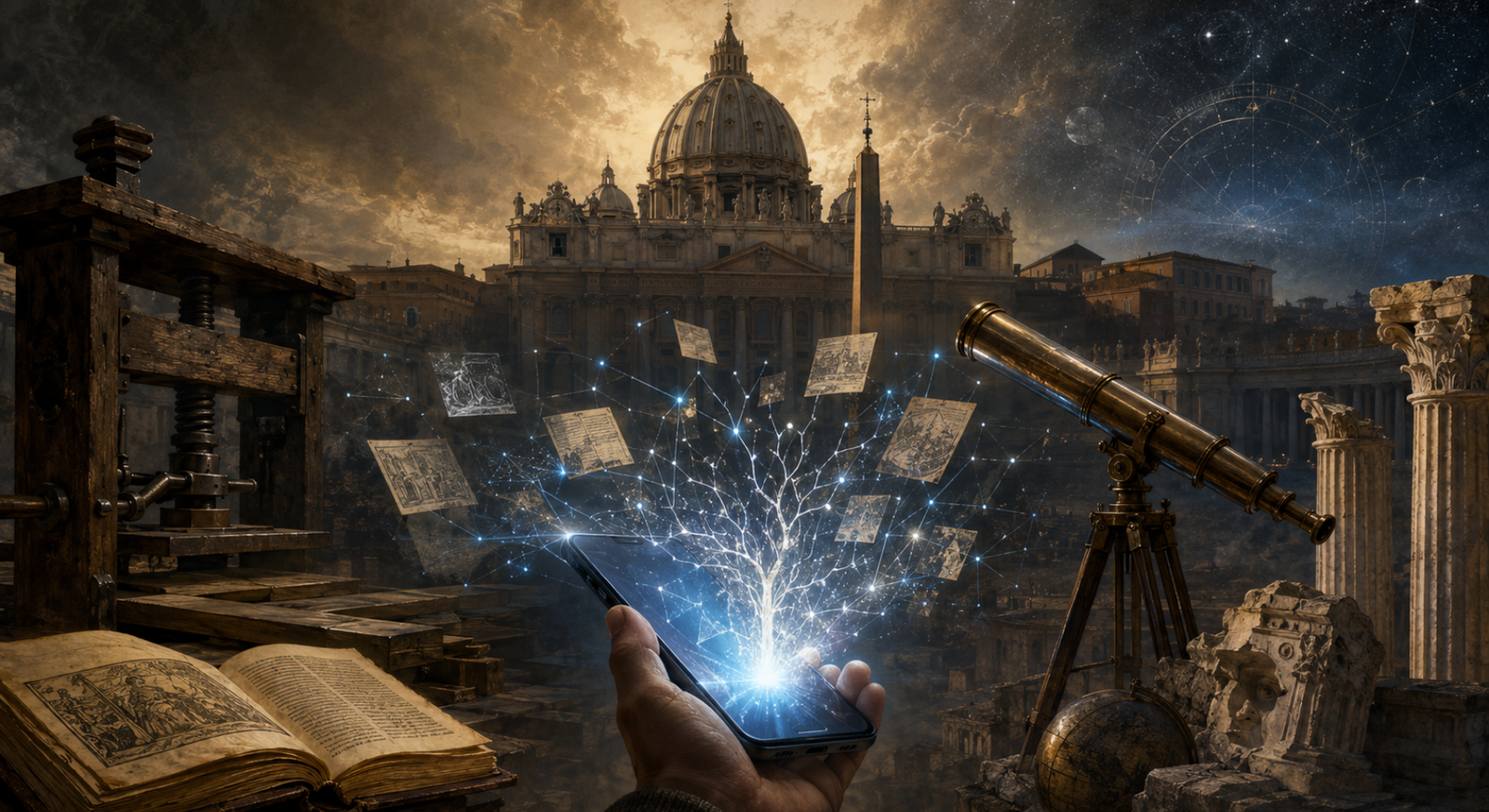
The printing press changed what people could read.
The telescope changed what humans could see.
The internet changed what people could access and communicate.
Artificial intelligence is changing what people can know—and what anyone with a phone can ask, compare, investigate, connect, challenge and question instantly, from almost anywhere, 24 hours a day.
New technologies don’t merely give us new tools.
Sometimes they give us new ways to discover that what we were taught was true wasn’t true at all.
Maybe AI doesn’t threaten faith itself.
Maybe what it threatens is something much older:
the authority to determine which questions get asked, which histories get remembered, what people are permitted to know—and who gets to provide the answers.

You may also like