

How to Take the Pressure Off Orgasm for You and Your Partner
Why trying harder can sometimes make orgasm harder and what research tells us about reducing orgasm pressure and returning attention to pleasure, presence, and flow.
Orgasm matters.
However, when a woman wants to orgasm and struggles to get there, orgasm pressure can begin to build. That pressure may come from within, from a partner, or from both.
The problem begins when orgasm stops being an experience and becomes a requirement.
Internal pressure may sound like:
Why am I not orgasming?
I’m taking too long.
Why can’t I just let go?
Something must be wrong with me.
Meanwhile, pressure from a partner may sound like:
Are you close?
Did you come?
Why aren’t you coming?
Pressure can also be communicated without words. For example, a partner may try harder and faster, become impatient, show disappointment, treat orgasm as the goal of sex, or continue stimulation when the woman wants to stop.
In Episode 6 of The Orgasm Hour Q&A, I explored both sides of orgasm pressure and the research behind them.
The science points to an important distinction:
Prioritizing a woman’s pleasure is not the same as requiring her to orgasm.
How Orgasm Pressure Can Turn Pleasure Into Performance
One of the clearest bodies of research on female orgasm concerns what is happening cognitively during sexual activity.
In a 2017 study, Tavares, Laan, and Nobre studied 926 sexually active women. Failure and disengagement thoughts and a lack of erotic thoughts were significant negative predictors of orgasm, while positive affect was a positive predictor.
In other words, the mental space occupied by thoughts such as Why isn’t this happening? or I’m failing is not neutral.
Instead, those thoughts compete for attention with the erotic experience itself.
A second study by Moura, Tavares, and Nobre compared 250 women who reported orgasm difficulties with 250 age-matched women who did not. Women with orgasm difficulties reported greater sexual inhibition, more negative automatic thoughts, including thoughts involving failure and disengagement, fewer erotic thoughts, more negative affect, and less positive affect during sexual activity.
This helps explain something many women know intuitively: you can become so busy assessing whether you are having an orgasm that you are no longer fully inside the experience that might allow orgasm to emerge.
Instead of experiencing:
What am I feeling?
the mind starts asking:
Am I close yet?
Those are very different attentional states.
How “Spectatoring” Can Make It Harder to Orgasm
This phenomenon has long been described in sexology as spectatoring, essentially watching and evaluating your own sexual performance instead of becoming absorbed in the sensations of the experience.
Dove and Wiederman studied cognitive distraction during partnered sexual activity and found that greater distraction was associated with lower sexual satisfaction, lower sexual esteem, less consistent orgasm, and more frequent pretending of orgasm.
Because this was correlational research, we cannot say cognitive distraction always causes orgasm difficulty. But the pattern across these studies is striking.
Performance monitoring and orgasm do not appear to make particularly good companions.
Pressure turns sex into an evaluation:
Is it happening? Am I doing this right? How long is this taking? What does my partner think? Why can’t I do it?
Every one of those questions takes attention somewhere other than the erotic experience.
Orgasm Pressure Can Also Come From a Partner
This is where the science becomes particularly interesting.
Most of us would consider wanting our partner to orgasm a positive thing. And it can be.
There is an enormous difference, however, between:
“I care about your pleasure.”
and
“I need you to orgasm.”
Why might a partner need the orgasm?
Chadwick and van Anders explored exactly this question in an experiment involving 810 men. Men imagined a sexual encounter in which a female partner either did or did not orgasm. Men reported feeling more masculine and having higher sexual esteem when they imagined that the woman orgasmed. The effect on masculinity was stronger among men with greater masculine gender-role stress.
That finding raises an important possibility.
A woman’s orgasm can shift from being her experience of pleasure to being interpreted as evidence of her partner’s sexual competence.
Suddenly, there are two people invested in what her body does.
And now her orgasm has a job.
It may have to prove that the sex was successful. In addition, it may be expected to prove that her partner is a good lover or reassure them that she enjoyed the encounter.
That is a lot to ask of an involuntary physiological and psychological response.
When Encouragement Becomes Orgasm Pressure
Researchers Chadwick and van Anders have also studied what they call orgasm coercion.
In a study of 912 participants with diverse gender, sex, and sexual identities, they examined experiences of being pressured by a partner to orgasm. Orgasm-pressure tactics resembled tactics found in sexual coercion research and were associated with faking orgasm and negative psychological and relationship outcomes.
The behaviors participants described included repeated questioning, implying that the person who did not orgasm was at fault, guilt, disappointment, continuing sexual activity, demanding orgasm, and impatience. Some participants reported that partners continued sexual activity even after they had indicated that they wanted to stop.
Importantly, this does not mean that asking “Are you close?” once is automatically coercive.
Context matters.
There is a significant difference between curiosity or communication and persistent questioning accompanied by disappointment, blame, anger, guilt, pressure to continue, or the expectation that someone must orgasm to protect their partner’s feelings.
Sometimes the pressure is even presented as generosity:
But I just want you to feel good.
The intention may genuinely be caring. Yet once the person receiving the stimulation says she feels good enough, wants to change what is happening, or wants to stop, caring means listening.
The Emotional Consequences of Orgasm Pressure
A second study by Chadwick and van Anders looked specifically at 308 people who had experienced orgasm coercion.
More frequent experiences of coercion, lower orgasm frequency with partners, and coercion involving emotional or physical threats predicted more negative relationship and psychological outcomes. Among cisgender women, pressure involving implied fault was particularly associated with negative relationship outcomes. Participants described experiences including anxiety, guilt, disappointment, and lasting relationship effects.
This also helps us understand why some people fake orgasm.
Faking may not always be about deceiving a partner.
Sometimes it may be a way of ending the pressure.
If orgasm has become the only acceptable conclusion to the encounter, performing an orgasm can become the quickest way to make the encounter, the questions, or the partner’s disappointment stop.
And that is the opposite of what we should be trying to create in a sexual relationship.
What Happens When We Take the Pressure Off Orgasm?
If monitoring, evaluation, pressure, and performance pull attention away from sexual experience, what might happen when attention moves more deeply into the experience?
This is where research on flow becomes particularly interesting.
Jamea, McCaskill, and Needle studied 100 people in monogamous relationships and examined the relationship between flow and sexual satisfaction. Flow was a statistically significant positive predictor of both personal and partner-focused sexual satisfaction, with no statistically significant gender differences.
The study did not prove that flow causes orgasm, nor was it specifically an orgasm-treatment study.
But conceptually it gives us a fascinating opposite to spectatoring.
Spectatoring involves observing, evaluating, and monitoring yourself.
Flow involves absorption.
Your attention is in the experience rather than outside it judging the experience.
That is why I said something during the episode that I think captures the central idea:
The flow state allows orgasm to become a consequence, not a goal.
There is an enormous difference between being intimately connected with another person while experiencing pleasurable stimulation and thinking:
We are going to make this orgasm happen.
The stimulation itself may be identical.
The state of mind is not.
How to Take the Pressure Off Orgasm
So how do we actually translate this research into sexual experiences?
1. Stop using orgasm as the scorecard
Orgasm can absolutely be desired.
But sex does not have to be classified as successful or unsuccessful according to whether an orgasm occurred.
Instead of asking only, Did I orgasm?, notice what else happened.
Was there pleasure? Arousal? Connection? Sensuality? Excitement? Curiosity? Absorption? Fantasy? Safety? Intimacy?
Removing the pass/fail test does not mean giving up on orgasm. It means creating more psychological space in which orgasm may occur.
2. Notice when you leave your body and enter evaluation
You may notice thoughts such as:
Why isn’t it happening?
I’m taking forever.
I’m losing it.
My partner is getting tired.
I should be closer by now.
When these thoughts appear, you do not need to fight them.
Instead, notice the thought and gently bring your attention back to the erotic experience.
Ask yourself:
What feels pleasurable right now?
Where do I notice sensation?
What rhythm does my body want?
Is a fantasy beginning to emerge?
You might also notice what happens when you breathe, move, make sound, or simply stay with a pleasurable sensation for another moment.
Most importantly, the goal is not to force yourself not to think. That would simply create another performance requirement.
Rather, the goal is to keep giving your attention somewhere more erotically useful.
3. Partners: stop making orgasm your mission
Being invested in your partner’s pleasure is wonderful.
But her orgasm is occurring within her, not as a performance review of you.
Technique matters. Knowing a woman’s anatomy matters. Listening matters. Learning what stimulation she enjoys matters.
But even excellent stimulation does not entitle anyone to an orgasm.
Instead of repeatedly asking, Are you close?, communication can remain focused on experience:
Does this feel good?
Do you want the same thing or something different?
More, less, slower, faster?
Do you want to keep going?
Those questions leave the person in charge of her experience without requiring her body to produce a particular result.
4. Never respond to a lack of orgasm with disappointment or blame
If your partner does not orgasm, avoid responding with disappointment, guilt, or blame.
That means:
- No sulking
- No “What’s wrong?”
- No “Why can’t you come?”
- No “But I worked so hard.”
- No continuing stimulation after someone wants it to stop
A woman who does not orgasm should not also have to manage her partner’s disappointment about what her body did or did not do.
Instead, respect what she communicates about her experience.
5. Talk about orgasm pressure outside the sexual encounter
This was one of the recommendations I emphasized during the episode.
You do not have to wait until you are in the middle of sex to have every conversation about sex.
Instead, talk during a relaxed moment. For example, the conversation might happen over dinner, during a walk, or sometime after intimacy.
You might say:
“I’ve noticed I start feeling pressure when orgasm becomes the goal.”
Or:
“Sometimes when you repeatedly ask whether I’m close, I stop paying attention to what I’m actually feeling.”
Having these conversations outside the sexual encounter can make communication easier when intimacy actually begins.
6. Create conditions that support absorption
Flow cannot simply be commanded.
But we can create conditions that make absorption more possible: privacy, enough time, emotional and physical safety, pleasurable stimulation, reduced interruption, curiosity, attention to sensation, and freedom from evaluation.
The shift is from:
How do I make myself orgasm?
to:
How deeply can I enter this experience?
That may be one of the most important changes we can make.
Orgasm can matter without becoming a demand
Taking pressure off orgasm does not mean telling women that orgasm is unimportant.
It does not mean accepting unsatisfying sex.
And it certainly does not mean that partners should stop caring about women’s orgasms.
It means understanding that there is a difference between supporting orgasm and requiring orgasm.
The research on automatic thoughts, cognitive distraction, sexual inhibition, partner expectations, orgasm coercion, and flow converges around an important idea:
When attention shifts from pleasure toward monitoring, judgment, reassurance, and performance, the sexual experience changes.
So perhaps we need to stop chasing orgasm quite so hard and start becoming more interested in creating the conditions in which orgasm can emerge.
Safety.
Pleasure.
Attention.
Connection.
Absorption.
Freedom from judgment.
And sometimes, surprise.
As I said at the end of Episode 6, the foundation is safety. From there, we can quiet some of the evaluation, move toward a more relaxed and absorbed state, and create room for orgasm rather than demanding that it appear.
Care deeply about orgasm. Learn about orgasm. Communicate about orgasm. Prioritize women’s pleasure.
But don’t turn orgasm into another performance requirement.
Watch the Live Episode
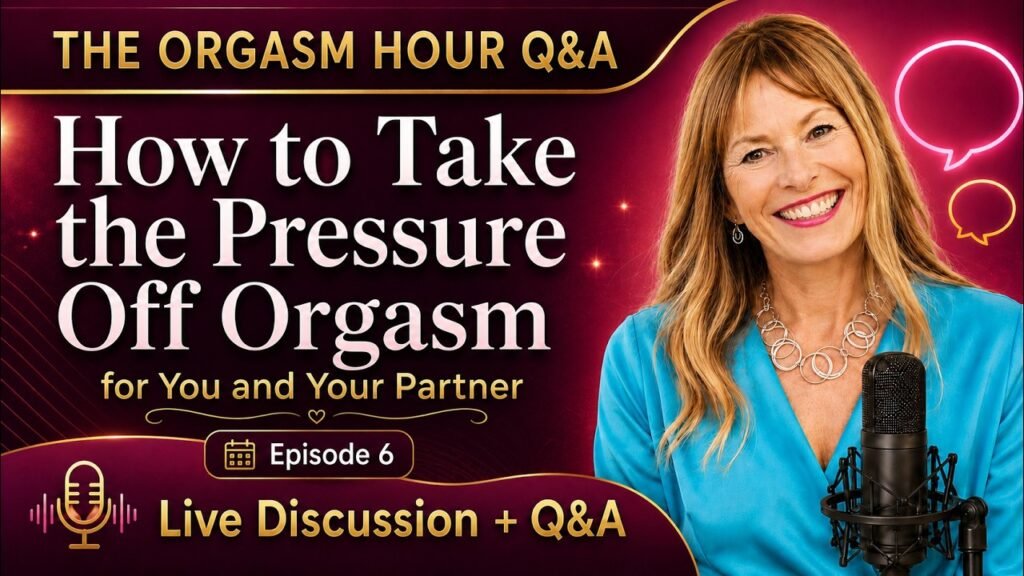
This article was adapted from Episode 6 of The Orgasm Hour Q&A with Dr. Suzanne Mulvehill.
In the full episode, I explore orgasm pressure, spectatoring, cognitive distraction, partner expectations, flow, and how couples can create sexual experiences that focus more on pleasure and less on performance.
You can watch this episode at https://www.youtube.com/live/uhvCuYIXsrc?si=k8dZrs0iuIMM6XtL
References
- Tavares IM, Laan ETM, Nobre PJ. Cognitive-Affective Dimensions of Female Orgasm: The Role of Automatic Thoughts and Affect During Sexual Activity. The Journal of Sexual Medicine. 2017;14(6):818–828. doi:10.1016/j.jsxm.2017.04.004.
- Moura CV, Tavares IM, Nobre PJ. Cognitive-Affective Factors and Female Orgasm: A Comparative Study on Women With and Without Orgasm Difficulties. The Journal of Sexual Medicine. 2020;17(11):2220–2228. doi:10.1016/j.jsxm.2020.08.005.
- Dove NL, Wiederman MW. Cognitive Distraction and Women’s Sexual Functioning. Journal of Sex & Marital Therapy. 2000;26(1):67–78. doi:10.1080/009262300278650.
- Chadwick SB, van Anders SM. Do Women’s Orgasms Function as a Masculinity Achievement for Men? The Journal of Sex Research. 2017;54(9):1141–1152. doi:10.1080/00224499.2017.1283484.
- Chadwick SB, van Anders SM. Orgasm Coercion: Overlaps Between Pressuring Someone to Orgasm and Sexual Coercion. Archives of Sexual Behavior. 2022;51:633–651. doi:10.1007/s10508-021-02156-9.
- Chadwick SB, van Anders SM. Orgasm Coercion and Negative Relationship and Psychological Outcomes: The Role of Gender, Sexual Identity, Perpetration Tactics, and Perceptions of the Perpetrator’s Intentions. Archives of Sexual Behavior. 2022;51:653–671. doi:10.1007/s10508-021-02162-x.
- Jamea EN, McCaskill LA, Needle RB. Sexual Satisfaction: Exploring the Role of Flow. Journal of Sex & Marital Therapy. 2021;47(5):481–491. doi:10.1080/0092623X.2021.1898503.

You may also like

How to Learn to Orgasm in More Than One Way