

“I’m So Close, But I Can’t Get There”: What May Be Interrupting Orgasm?
Many women describe the same frustrating experience:
“I get so close, but I can’t get there.”
That description is important because it tells us something is happening. Pleasure is building. Arousal is increasing. The woman may feel she is approaching orgasm, but then the response changes.
Rather than treating every version of “I can’t orgasm” as the same problem, it may be more useful to examine the sequence:
What happens as arousal builds, and what changes right before the response is lost?
Research on female sexual functioning suggests that attention, distraction, automatic thoughts, inhibition, and affect can all influence sexual response and orgasm (Adams et al., 1985; Cuntim & Nobre, 2011; Dove & Wiederman, 2000; Moura et al., 2020; Salemink & van Lankveld, 2006).
Two recent Reddit posts illustrate why identifying the specific pattern may matter.
Case Analysis 1: “My Brain Stops” Before Orgasm
One woman described being able to orgasm during solo clitoral stimulation but repeatedly being unable to orgasm during sex with her boyfriend.
She explained that penetration felt pleasurable and sometimes overwhelming. She would become “SO close” to climax, but then experience pressure that made her think she might need to pee or fart.
Then, in her words:
“I feel like my brain stops.”
What Does This Tell Us About Her Orgasm Difficulty?
This woman has already demonstrated that she is capable of orgasm.
That changes the question.
Instead of asking:
Can she orgasm?
We can ask:
Why is orgasm accessible in one context but interrupted in another?
Her experience appears to follow this sequence:
Pleasure → increasing intensity → getting very close → pressure sensation → thoughts about peeing or farting → response stops
The pressure sensation itself may or may not be the primary problem.
What stands out is the apparent change in attention. She moves from experiencing pleasure to evaluating what her body might be doing.
How Cognitive Distraction May Interrupt Orgasm
Researchers have investigated the relationship between cognitive distraction and female sexual response for decades.
Adams et al. (1985) experimentally examined cognitive distraction during female sexual arousal and found that distraction could interfere with aspects of sexual responding.
Dove and Wiederman (2000) later found that women reporting greater cognitive distraction during partnered sexual activity also reported less consistent orgasm and lower sexual satisfaction.
For women who experience this kind of self-monitoring, understanding how to take the pressure off orgasm may be another useful starting point.
In another experiment, Salemink and van Lankveld (2006) increased neutral distraction during sexual stimulation. Greater distraction impeded genital sexual responding and retrospectively reported subjective sexual responding in women with and without sexual problems.
Research focused specifically on orgasm provides another important piece.
Cuntim and Nobre (2011) found that women with orgasm difficulties reported more distracting automatic thoughts during sexual activity.
A lack of erotic thoughts was particularly important. Women with orgasm difficulties also reported thoughts involving failure, disengagement, control, sexual passivity, and partner affection.
Moura et al. (2020) found similar patterns. Compared with women without orgasm difficulties, women experiencing orgasm problems reported:
- Greater sexual inhibition
- More negative automatic thoughts
- Fewer erotic thoughts
- Greater negative affect
- Lower positive affect
These findings do not mean that a single distracting thought necessarily causes orgasm difficulty.
They do, however, give us a scientific reason to pay attention when a woman says:
“Everything feels good, I get very close, and then my brain changes.”
What Might Be Interrupting Her Orgasm?
For this woman, possible interruptions include:
- Self-monitoring or embarrassment
- Concern about bodily functions
- Fear of losing control
- Increased awareness of her partner
- Attention shifting away from erotic sensation
- Evaluating whether orgasm is about to happen
We cannot determine from a Reddit post which of these factors is responsible.
But we can identify an important question:
What changes right before she loses it?
That gives us a specific moment to investigate.
Case Analysis 2: “I Knew I Had to Hold On, But I Couldn’t”
The second woman described a very different history.
She was 21 years old and had never experienced an orgasm. Previous attempts at masturbation had not worked, and she eventually gave up trying.
She also described feeling frustrated because her friends were experiencing orgasms while she was not.
Then she experimented with a shower head.
During one attempt, she experienced an unexpectedly intense response.
Her legs began shaking strongly. Her breathing became heavy. Her hearing felt muffled, and her vision became blurry.
She described feeling as though she were “flying.”
But the sensation became too intense.
She moved the shower head away, and the response immediately stopped.
She later wrote:
“I knew I had to hold on but I couldn’t.”
What Does This Tell Us About Her Sexual Response?
Unlike the woman in Case 1, this woman had no previous history of orgasm.
She did, however, describe a strong sexual response.
Her experience appears to follow this sequence:
Stimulation → rapid increase in intensity → strong bodily response → overwhelm → removes stimulation → response stops
This is not the same pattern we saw in Case 1.
The most obvious interruption is behavioral:
She removes the stimulation when the intensity becomes difficult to tolerate.
But that raises another question:
Why does she pull away at that particular moment?
Possible explanations could include:
- Sensory overwhelm
- Unfamiliar intensity
- Fear of losing control
- Uncertainty about what is happening
- An automatic withdrawal response when stimulation becomes intense
Again, these are possibilities, not diagnoses.
We also cannot conclude that she would definitely have orgasmed if she had continued.
What we can say is that she has identified a remarkably specific moment at which the response changes.
Why Getting Close to Orgasm Can Mean Different Things
Both women might say:
“I was so close, but I couldn’t get there.”
Yet their patterns look different.
Case 1
Pleasure builds
↓
She gets close to orgasm
↓
An unusual pressure sensation appears
↓
Attention shifts toward monitoring and concern
↓
“My brain stops”
Case 2: Intensity Becomes Overwhelming
Pleasure builds
↓
Sexual intensity becomes extremely strong
↓
The experience becomes difficult to tolerate
↓
She removes the stimulation
↓
The response stops.
The complaint sounds the same, but the interruption may not be.
Same complaint. Different interruption.
This distinction may be clinically important because different patterns may require different questions and approaches.
The Hope-Frustration Cycle: When Trying to Orgasm Creates More Pressure
Repeated experiences of getting close without reaching orgasm may also create a second problem.
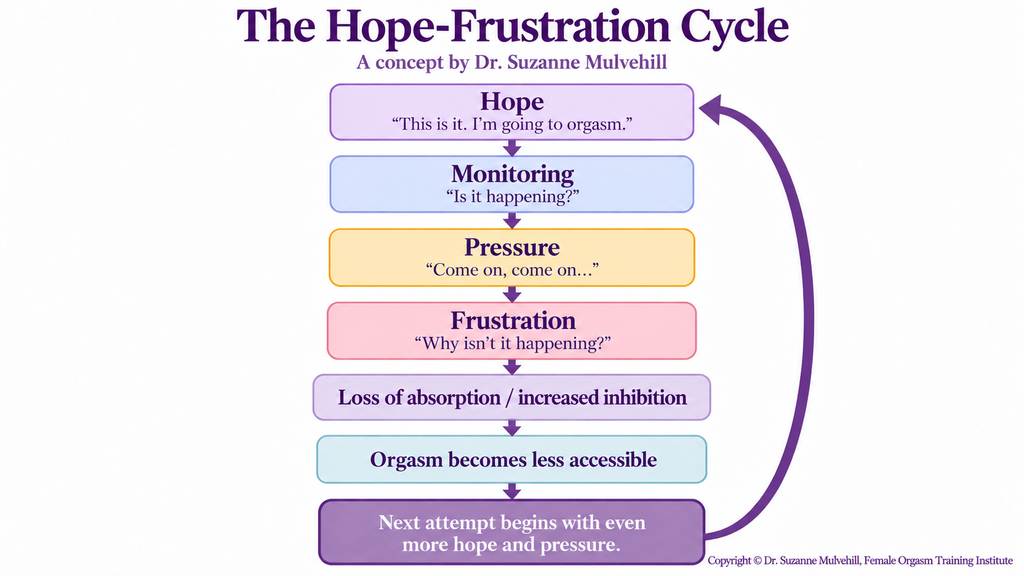
I call this the Hope-Frustration Cycle.
A woman begins an experience hoping that this time will be different.
Hope: This is it. Maybe I’m going to orgasm.
As pleasure builds, she begins monitoring herself.
Monitoring: Is it happening yet?
Monitoring can gradually become pressure.
Pressure: Come on. Come on.
If orgasm does not occur, that pressure may turn into frustration.
Frustration: Why isn’t this happening?
The frustration may increase inhibition and make it harder to remain absorbed in the experience.
The next attempt may then begin with even more expectation.
How the Hope-Frustration Cycle Works
Hope → Monitoring → Pressure → Frustration → Increased inhibition / reduced absorption → Orgasm becomes less accessible → More pressure during the next attempt
The Hope-Frustration Cycle is a proposed educational and clinical concept, not an established diagnostic construct.
Research on cognitive distraction, negative automatic thoughts, sexual inhibition, and orgasm difficulty provides a scientific context for exploring why repeated monitoring and pressure may matter (Cuntim & Nobre, 2011; Dove & Wiederman, 2000; Moura et al., 2020).
How to Identify What May Be Interrupting Orgasm
These two cases led me to a simple practical framework:
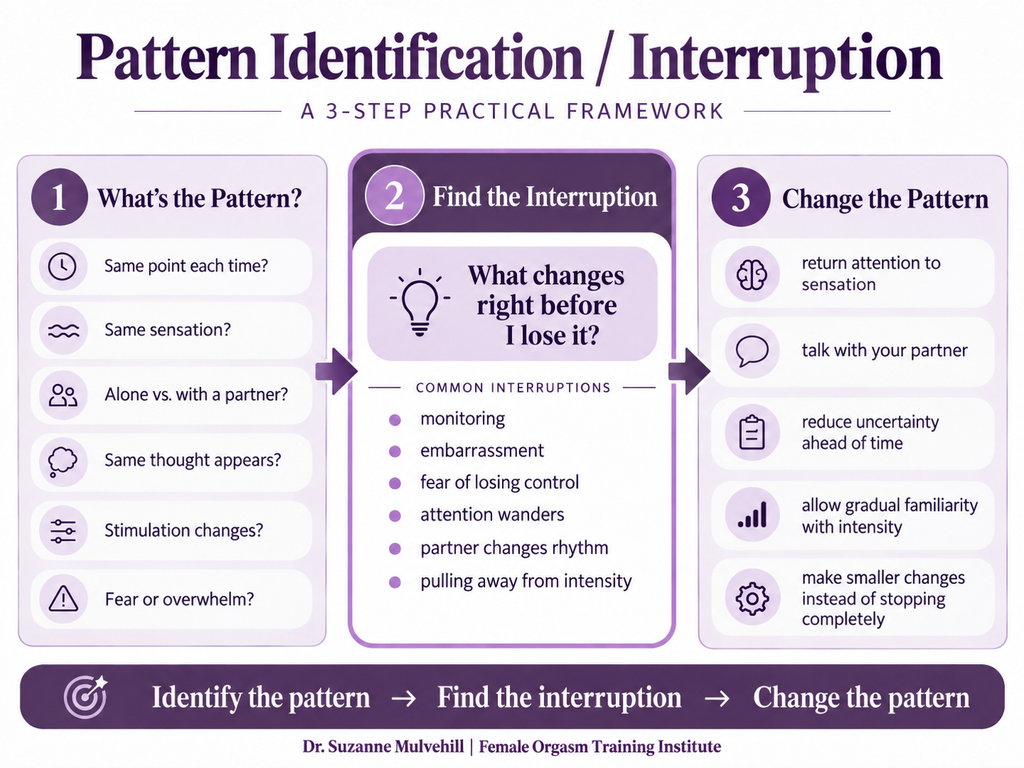
Identify the Pattern → Find the Interruption → Change the Pattern
The purpose is not to diagnose a woman based on one experience. It is to understand what happens as her sexual response develops.
Step 1: Identify the Pattern
Start by looking at the sequence rather than focusing only on the outcome.
Ask yourself:
- Does the response stop at approximately the same point?
- Does the same physical sensation appear?
- Does a particular thought interrupt the experience?
- Is the experience different alone versus with a partner?
- Does the stimulation or rhythm change?
- Does fear appear?
- Does the intensity become overwhelming?
The goal is to move beyond:
“I didn’t orgasm.”
Instead, examine what happened before the response stopped.
Step 2: Find the Interruption
The key question is:
What changes right before I lose it?
Possible interruptions include:
- Checking whether orgasm is happening
- Worrying about urinating or passing gas
- Feeling embarrassed
- Thinking about a partner’s expectations
- Fear of losing control
- Sensory overwhelm
- Changing stimulation or rhythm
- A partner changing rhythm
- Attention wandering
- Trying harder and harder to make orgasm happen
Identifying an interruption does not necessarily reveal a single underlying cause.
It identifies a moment worth investigating.
Step 3: Change the Pattern
Once the interruption becomes more visible, a woman can experiment with that specific point in the sequence.
If the interruption involves self-monitoring: She might experiment with returning her attention to sensation instead of repeatedly checking whether orgasm is happening.
If embarrassment is involved: Talking with a partner beforehand may help reduce uncertainty about normal bodily sensations.
If she worries about urinating or passing gas: She might empty her bladder beforehand, place a towel nearby, or discuss her concerns with her partner.
If sexual intensity becomes overwhelming: The goal should not automatically be to push through the experience. Instead, she might gradually become more familiar with increasing intensity while maintaining comfort, safety, and control.
If she repeatedly removes stimulation at the same point: She might experiment with a smaller adjustment in intensity rather than stopping completely, provided the experience remains comfortable.
This framework is not about ignoring pain or overriding distress.
It is about becoming curious about the moment when a familiar pattern changes.
Can’t Reach Orgasm? Getting Close Is Information
When a woman repeatedly becomes highly aroused and gets close to orgasm, that experience is not simply a failure.
Getting close is information.
Something is building.
The more useful question may not always be:
Why can’t I orgasm?
It may be:
What changes right before I lose it?
This shifts the focus away from failure and toward understanding the pattern.
Identify the pattern.
Find the interruption.
Change the pattern.
Two women can describe the same orgasm difficulty and still need to investigate very different moments in their sexual response.
Understanding that difference may be an important step toward learning why orgasm becomes accessible in some situations but not others.
References
Adams, A. E., III, Haynes, S. N., & Brayer, M. A. (1985). Cognitive distraction in female sexual arousal. Psychophysiology, 22(6), 689–696. https://doi.org/10.1111/j.1469-8986.1985.tb01669.x
Cuntim, M., & Nobre, P. (2011). The role of cognitive distraction on female orgasm. Sexologies, 20(4), 212–214. https://doi.org/10.1016/j.sexol.2011.08.001
Dove, N. L., & Wiederman, M. W. (2000). Cognitive distraction and women’s sexual functioning. Journal of Sex & Marital Therapy, 26(1), 67–78. https://doi.org/10.1080/009262300278650
Moura, C. V., Tavares, I. M., & Nobre, P. J. (2020). Cognitive-affective factors and female orgasm: A comparative study on women with and without orgasm difficulties. The Journal of Sexual Medicine, 17(11), 2220–2228. https://doi.org/10.1016/j.jsxm.2020.08.005
Salemink, E., & van Lankveld, J. J. D. M. (2006). The effects of increasing neutral distraction on sexual responding of women with and without sexual problems. Archives of Sexual Behavior, 35(2), 179–190. https://doi.org/10.1007/s10508-005-9014-2

You may also like

The Price of an Orgasm: What Are Women Willing to Risk?

Why Orgasm Treatments Often Fail: 7 Gaps in Female Orgasm Care