

Why Orgasm Treatments Often Fail: 7 Gaps in Female Orgasm Care
Why do some women seek help for orgasm difficulty, try treatment, and still struggle to orgasm?
The problem is not always that women fail to seek help. Many women do seek help. They may try sex therapy, behavioral approaches, directed masturbation, sensate focus, psychotherapy, cognitive-behavioral strategies, vibrators, mindfulness, or other recommendations. Yet even after treatment, some women still struggle to gain reliable orgasmic access.
Female orgasm treatments do not work equally well for everyone. Female Orgasmic Disorder/Difficulty (FOD) can involve lifelong, acquired, generalized, or situational presentations, and treatment responses vary considerably.
Moreover, relatively few treatments have been empirically validated, while psychological and behavioral approaches have seen limited innovation since the 1980s (Marchand, 2021; Mulvehill, 2026).
This raises a larger question:
What is missing from the way female orgasm difficulty is understood and treated?
Research points to seven important gaps.
Gap #1: Female Orgasm Treatment Research Is Outdated
Some of the foundational research still used to guide treatment for female orgasm difficulty dates back to the 1970s and 1980s.
Marchand’s review found the most consistent support for directed masturbation, sensate focus, and psychotherapy. At the same time, she concluded that treatment of FOD has seen little innovation since the 1980s. She called for more research into why some women do not improve and how treatment can be better tailored (Marchand, 2021).
However, this does not mean older treatments are ineffective. Some produced meaningful results. For example, Riley and Riley (1978) found that 18 of 20 women receiving directed masturbation plus sensate focus became orgasmic, compared with 8 of 15 receiving sensate focus alone.
Therefore, the concern is not that treatments have never worked.
It is how little the treatment landscape has evolved.
Gap #2: Traditional Sexual Response Models Have Limitations
Classic models of sexual response shaped modern sexual medicine.
In 1966, Masters and Johnson proposed a linear sexual-response model:
Excitement → Plateau → Orgasm → Resolution
In 1979, Kaplan proposed:
Desire → Arousal → Orgasm
In 2000, Basson proposed a nonlinear, circular model of female sexual response that expanded the field by incorporating motivation, relational context, emotional intimacy, responsive desire, and satisfaction (Basson, 2000; Kaplan, 1979; Masters & Johnson, 1966; Mulvehill, 2026).
These models were important advances. Masters and Johnson and Kaplan generally conceptualized orgasm as emerging through sufficient stimulation and arousal, while Basson broadened sexual response to include relational and emotional factors.
However, these dominant models do not explicitly account for the full range of non-genital, cognitive, somatic, hypnotic, breath-based, and altered-state pathways through which orgasm may become accessible (Mulvehill, 2026).
Research has documented orgasmic responses or experiences associated with multiple pathways, including genital stimulation, non-genital stimulation, fantasy and imagery, hypnotic induction, pelvic-floor and somatic practices, tantra and breathwork, cannabis-associated states, and LSD-assisted psychotherapy (Komisaruk & Whipple, 2011; Mulvehill, 2026; Pfaus & Tsarski, 2022).
The evidence supporting these pathways varies considerably. Nevertheless, the findings suggest that traditional models may not fully explain the range of conditions under which orgasm becomes accessible.
This raises a different question.
Traditionally, treatment has often focused on:
How do we increase arousal and reduce barriers to orgasm?
The emerging question may be:
What allows a woman to transition into an orgasm-supportive state, regardless of the pathway used to get there?
The Orgasmic Learning framework proposes that diverse pathways may converge on a shared therapeutic target: facilitating a transition into an altered, absorbed, or otherwise orgasm-supportive state in which orgasmic response becomes more accessible (Mulvehill, 2026).
Gap #3: Not All Types of Female Orgasm Difficulty Are Studied Equally
Female orgasm difficulty is not one uniform problem.
A woman may experience:
- Lifelong orgasm difficulty
- Acquired orgasm difficulty
- Generalized difficulty
- Situational difficulty
- Reliable orgasm alone but not with a partner
- Delayed orgasm
- Reduced orgasm intensity
- Complete absence of orgasm
Yet much of the older treatment literature focused on women described as having primary anorgasmia, which most closely resembles lifelong, generalized FOD with no prior orgasm experience.
An earlier review of empirically validated sexual dysfunction treatments highlighted the limited evidence base for orgasm-specific treatments, particularly outside primary anorgasmia (Heiman & Meston, 1997).
More recently, Marchand (2021) found that treatment outcomes were generally stronger for lifelong or generalized FOD than for acquired or situational presentations. She also called for better understanding of why some women do not respond to treatment.
Consequently, improving female orgasm treatments requires more than developing additional interventions.
We need evidence that tells us which treatments work for different types of orgasm difficulty.
Gap #4: Treatment Studies Do Not Always Measure Orgasm Directly
One of the most widely used instruments in women’s sexual-health research is the Female Sexual Function Index, or FSFI, a validated 19-item measure covering six domains of female sexual function (Rosen et al., 2000).
It measures:
- Desire
- Arousal
- Lubrication
- Orgasm
- Satisfaction
- Pain
That is clinically useful because women’s sexual functioning is multidimensional. However, it also means orgasm may be evaluated as one part of a broader sexual-function picture rather than as the central treatment outcome.
For example, a woman can improve in desire, arousal, satisfaction, pain, or overall sexual functioning while still having an unresolved orgasm problem.
This distinction is particularly important because much of the evidence for psychological, cognitive, and mindfulness-based approaches comes from broader female sexual dysfunction populations or composite sexual-function outcomes rather than exclusively from women being treated for FOD (Mulvehill, 2026).
For a woman seeking treatment because she cannot orgasm, the questions may be more direct:
- Can I orgasm now?
- Is the response reliable?
- Under what conditions does it occur?
- Can I reproduce it?
- Will I maintain the ability over time?
- Can I eventually access orgasm in other situations or with a partner?
Overall sexual health matters. Nevertheless, when orgasm is the presenting problem, orgasm itself must remain a central treatment outcome.
Gap #5: Female Orgasmic Disorder Lacks a Clear Treatment Pathway
The contrast with erectile dysfunction is striking.
Erectile dysfunction has multiple condition-specific treatment options incorporated into established clinical care. These include oral PDE5 inhibitors such as Viagra and Cialis, vacuum erection devices, penile injections, and penile prostheses when appropriate.
Female Orgasmic Disorder does not have a comparable, clearly defined condition-specific pathway.
Traditional approaches include psychoeducation, directed masturbation, sensate focus, psychotherapy, cognitive-behavioral interventions, mindfulness-based approaches, and other behavioral or psychosexual strategies (Marchand, 2021; Mulvehill, 2026).
These approaches can be valuable.
However, if a woman enters treatment saying:
“I can’t orgasm.”
What is the actual clinical pathway for treating that specific problem?
And if the first intervention does not work: What comes next?
Gap #6: There Is No Validated Sequence for Female Orgasm Treatments
This is different from simply lacking treatment options.
A list of available treatments is useful, but it does not tell clinicians which intervention should come first, when to change approaches, or how to match treatment to a woman’s particular presentation.
A validated treatment hierarchy would help answer several questions:
- Which treatment should come first?
- Which approach is appropriate for this woman?
- If an intervention fails, what should follow?
- Which mechanisms should guide the decision?
- How does the type of FOD affect treatment selection?
The Orgasmic Learning review calls for a validated hierarchy of interventions and controlled comparative research. Such studies could help determine which pathways produce clinically meaningful improvements, for whom, under what conditions, and through which mechanisms (Mulvehill, 2026).
Therefore, knowing which treatments exist is not the same as knowing how to choose among them.
A validated treatment sequence would provide evidence-based guidance for making those decisions.
Gap #7: No Medication Is Specifically Approved for Female Orgasmic Disorder
There is currently no pharmacological treatment specifically approved for Female Orgasmic Disorder (Mulvehill, 2026).
That does not mean medication must be the answer for every woman. Instead, it illustrates another limitation in the current treatment landscape.
At the same time, historically overlooked and emerging pathways deserve scientific attention.
Cannabis is one example. Historical reports and more recent observational research have described associations between cannabis use and improved orgasm-related experiences in some women, including greater satisfaction and fewer reported difficulties reaching orgasm (Mulvehill & Tishler, 2024, 2025).
Historical accounts are especially interesting from an orgasmic-learning perspective.
Goode (1970) described a woman whose orgasmic response was initially accessible only while using cannabis. Similarly, Lewis (1970) described four women who learned to orgasm while using cannabis and later reported that they no longer required cannabis to do so.
However, these accounts do not establish cannabis as a universally effective or clinically validated treatment for FOD. More controlled research is needed to understand its potential benefits, risks, and mechanisms.
Instead, the historical observations raise a different scientific question:
Could some interventions work by temporarily creating the internal state in which orgasm becomes accessible, allowing the response to be learned, strengthened, and eventually generalized?
Toward an Orgasmic Learning Framework
Orgasmic Learning reframes FOD around orgasmic accessibility.
Instead of assuming there is one route to orgasm, the framework asks which pathway may be most accessible for the individual woman and what mechanisms may be interfering with orgasmic response.
Identify the Relevant Pathway
Which pathway appears most accessible or viable for this woman?
Match Intervention to Pathway
Which inhibitory, excitatory, sensory, attentional, relational, somatic, or state-dependent factors are most relevant to her orgasm difficulty?
Measure Orgasmic Accessibility
Did orgasm actually become more accessible? If so, how reliable is the response?
Can the woman reproduce it, and does that ability eventually transfer to other sexual situations?
The Orgasmic Learning framework conceptualizes orgasmic accessibility as a potentially trainable, state-dependent capacity. Through repeated engagement with orgasm-supportive states or conditions, access may become stronger and potentially more flexible across different contexts (Mulvehill, 2026).
This leads to a proposed sequence.
Access → Learning → Strengthening → Generalization
Access: Identify the conditions or pathway through which orgasm becomes possible.
Learning: Repeatedly experience and begin learning the response.
Strengthening: Reinforce orgasmic access so that it becomes more stable and reliable.
Generalization: Explore whether the response can become accessible across other circumstances, forms of stimulation, and sexual contexts.
What Does This Mean for Women?
If treatment has not worked, that does not automatically mean your orgasm problem cannot change.
Several possibilities deserve consideration:
- The treatment model may have been too narrow.
- The intervention may not have matched the pathway most accessible to you.
- Orgasm itself may not have been the primary treatment target.
- The response may have become accessible without being sufficiently strengthened or generalized.
Female orgasm difficulty deserves the same scientific seriousness applied to other health conditions. Moreover, women deserve more than generic advice or a list of treatments without clear guidance.
Research needs to answer several important questions:
What works? For whom? Under what conditions? And through which mechanisms?
Perhaps the better question is no longer only:
“Why can’t I orgasm?”
Instead, Orgasmic Learning invites us to consider another possibility:
“What pathway helps me access orgasm?”
Watch the Full Discussion
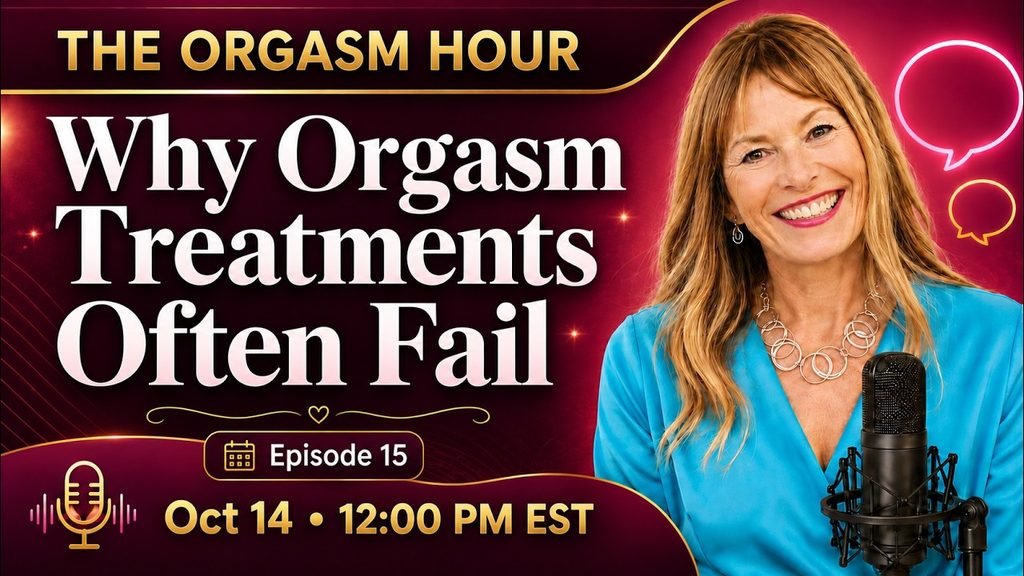
Watch The Orgasm Hour, Episode 15: Why Orgasm Treatments Often Fail for a deeper discussion of these seven treatment gaps and the emerging Orgasmic Learning framework.
References
Basson, R. (2000). The female sexual response: A different model. Journal of Sex & Marital Therapy, 26(1), 51–65. https://doi.org/10.1080/009262300278641 Goode, E. (1970). The marijuana smokers. Basic Books.
Heiman, J. R., & Meston, C. M. (1997). Empirically validated treatments for sexual dysfunction. Annual Review of Sex Research, 8(1), 148–194. https://doi.org/10.1080/10532528.1997.10559921
Kaplan, H. S. (1979). Disorders of sexual desire and other new concepts and techniques in sex therapy. Brunner/Mazel.
Komisaruk, B. R., & Whipple, B. (2011). Non-genital orgasms. Sexual and Relationship Therapy, 26(4), 356–372. https://doi.org/10.1080/14681994.2011.649252
Lewis, B. (1970). The sexual power of marijuana. Ace Books.
Marchand, E. (2021). Psychological and behavioral treatment of female orgasmic disorder. Sexual Medicine Reviews, 9(2), 194–211. https://doi.org/10.1016/j.sxmr.2020.07.007
Masters, W. H., & Johnson, V. E. (1966). Human sexual response. Little, Brown and Company.
Mulvehill, S. (2026). Orgasmic learning as a treatment framework for female orgasmic disorder/difficulty: A review using Perelman’s Sexual Tipping Point® model https://doi.org/10.1007/s11930-026-00428-w.
Mulvehill, S., & Tishler, J. (2024). Assessment of the effect of cannabis use before partnered sex on women with and without orgasm difficulty. Sexual Medicine, 12(2), qfae023. https://doi.org/10.1093/sexmed/qfae023
Mulvehill, S., & Tishler, J. (2025). Cannabis for female orgasmic disorder/difficulty: A systematic review. Sexual Medicine, 13(4), qfaf061. https://doi.org/10.1093/sexmed/qfaf061
Pfaus, J. G., & Tsarski, K. (2022). A case of female orgasm without genital stimulation. Sexual Medicine, 10(2), 100496. https://doi.org/10.1016/j.esxm.2022.100496
Riley, A. J., & Riley, E. J. (1978). A controlled study to evaluate directed masturbation in the management of primary orgasmic failure in women. British Journal of Psychiatry, 133, 404–409.
Rosen, R., Brown, C., Heiman, J., Leiblum, S., Meston, C., Shabsigh, R., Ferguson, D., & D’Agostino, R., Jr. (2000). The Female Sexual Function Index (FSFI): A multidimensional self-report instrument for the assessment of female sexual function. Journal of Sex & Marital Therapy, 26(2), 191–208. https://doi.org/10.1080/009262300278597

You may also like

Why Can’t I Orgasm? New Research on Learning to Orgasm

Why Did I Stop Having Orgasms?